


As President Joe Biden enters the final stretch of his term, he is poised to leave a historic legacy in the federal judiciary. With a record-breaking focus on diversity, Biden has appointed more judges of color to lifetime federal judgeships than any president before him, significantly reshaping the federal bench to better reflect America’s demographics.
The move comes after a landmark achievement of Biden’s tenure, the appointment of Justice Ketanji Brown Jackson to the U.S. Supreme Court. Sworn in on June 30, 2022, Jackson became the first Black woman to serve on the nation’s highest court, fulfilling a campaign promise to enhance representation at the Supreme Court level.
The Senate recently confirmed Tiffany Johnson as a judge for the Northern District of Georgia, making her the 40th Black woman Biden has appointed to lifetime federal judgeships—a milestone unmatched by any president in a single term. Johnson’s appointment highlights Biden’s unprecedented commitment to diversifying the judiciary.
“The research shows that when you have more judges with diverse perspectives, whether due to the issues they’ve worked on or the communities they represent, it improves decision-making and increases trust in these institutions,” said Lena Zwarensteyn, senior director of the fair courts program at the Leadership Conference on Civil and Human Rights. “Ensuring fair-minded judges at all levels is crucial.”
In comparison, former President Barack Obama appointed 26 Black women to lifetime judgeships during his two terms, while Donald Trump appointed two during his first term. Jimmy Carter appointed 37 Black judges during his single term, and both Obama and Bill Clinton appointed 62 Black judges across their respective two-term presidencies. If Benjamin Cheeks, another nominee awaiting Senate confirmation, is approved, Biden will surpass their record with 63 Black federal judges confirmed.
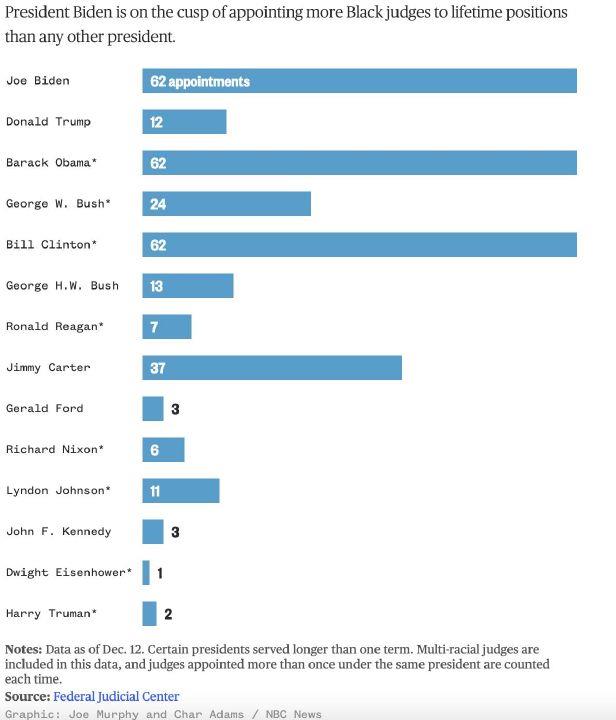
The numbers also include multiracial judges and those appointed to multiple courts by the same president. Overall, approximately 60% of Biden’s 233 confirmed judicial appointments are people of color, according to White House data.
Biden’s judicial impact is not limited to numbers—it reflects a broader vision of inclusivity. White House communications director Ben LaBolt noted that Biden is “proud to have strengthened the judiciary by making it more representative of the country as a whole,” adding that this legacy will shape the judicial system for decades.
Making history: Clemency Act
Another historic moment was made after Biden commuted the sentences of approximately 1,500 people who were released from prison and placed on home confinement during the COVID-19 pandemic and pardoned 39 individuals convicted of nonviolent crimes. This marks the largest single-day act of clemency in modern U.S. history. Among those pardoned, are three Texans: Lashundra Tenneal Wilson, 49, of Arlington; Mireya Aimee Walmsley, 57, of La Porte; and Nathaniel David Reed III, 46, of San Antonio.
“My administration will continue reviewing clemency petitions to advance equal justice under the law, promote public safety, support rehabilitation and reentry, and provide meaningful second chances,” Biden said in a statement. He also emphasized the importance of addressing sentencing disparities, particularly for nonviolent drug offenses.
The individuals pardoned span ages 36 to 75, with roughly equal numbers of men and women. Their offenses ranged from drug crimes to fraud and theft, and they have demonstrated significant rehabilitation. The pardoned include community leaders such as a church deacon turned addiction counselor, a doctoral student in molecular biosciences, and a decorated military veteran.
Among the notable cases is Trynitha Fulton, 46, of Louisiana, who was convicted in 2008 for her role in a payroll fraud scheme while working as a New Orleans middle school teacher. After completing her three-year probation, Fulton earned a master’s degree and now leads a nonprofit supporting youth through hot meals, shelter, and mental health services. “The pardon gives me a sense of freedom,” Fulton said, adding that it inspires her to make impactful decisions both personally and professionally.
This move surpasses former President Barack Obama’s single-day clemency act of 330 in 2017, further cementing Biden’s legacy of using executive power to address criminal justice inequities. Biden has also promised additional clemency measures in the weeks ahead.
Clemency, a constitutional power of the presidency, allows for pardons, which relieve guilt and punishment, and commutations, which reduce sentences without exonerating wrongdoing. While it is customary for presidents to grant clemency toward the end of their term, Biden’s sweeping actions reflect a broader focus on justice reform and rehabilitation.
As Biden considers further clemency decisions before leaving office, advocacy groups are urging him to address broader injustices, including federal death row sentences. He is also reportedly weighing preemptive pardons for those involved in investigations into former President Donald Trump’s efforts to overturn the 2020 election.
In a statement, Biden reflected on the broader significance of clemency: “America was built on the promise of possibility and second chances. As president, I have the great privilege of extending mercy to people who have demonstrated remorse and rehabilitation, restoring opportunity for Americans to participate in daily life and contribute to their communities.”
