


Harris County Sheriff Ed Gonzalez insists his mandate is simple: Serve everyone, even those who didn’t vote for him.
He won a third term last November with just over 53% of the vote, a narrow margin that underscores both the expectations and scrutiny now shadowing the leader of Texas’ largest sheriff’s office.
“When I die, I want to die on empty, not because I’m tired, but because I used every skill and talent I was blessed with for the greater good of just trying to leave the world a better place than I found it,” Gonzalez told the Defender.
Gonzalez’s initiatives

The Houston native recalls learning as a child that his father could not read or write and later, that his dad was once incarcerated in the very jail Gonzalez now oversees. That experience, he says, fueled his empathy and his fixation on navigators, systems and people who help others through complicated bureaucracies, from job applications to courtrooms.
Inside the jail, this has translated into partnerships with Houston Community College and trauma-informed programming, including a Women’s Empowerment Center.
“I’m concerned that women are the fastest-growing population in all jails and prisons,” Gonzalez said. “Historically, the criminal justice system was never truly designed with women in mind. At the Women’s Empowerment Center, we take a trauma-informed approach…to try to connect them to their children, address any other underlying issues, because we found, especially with women, that underneath, there’s a lot of unresolved trauma that was never dealt with.”
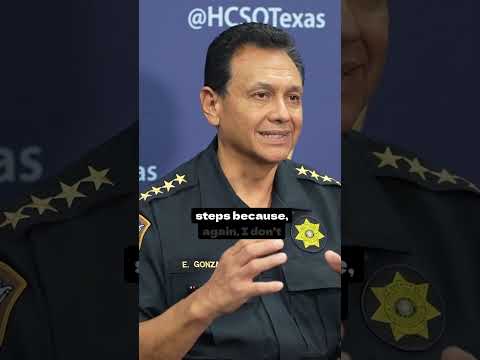
If Gonzalez’s rhetoric leans humane, his third term is defined by difficult problems in local criminal justice: A jail under remedial orders and intense public pressure after a string of in-custody deaths.
State regulators have repeatedly cited Harris County for non-compliance. As recently as June 30, 2025, the Texas Commission on Jail Standards issued another notice tied to deficiencies identified in late-June inspections. This summer, the Sheriff’s Office released a 17-minute video of 32-year-old Alexis Cardenas’ fatal encounter with jailers as he refused to leave upon release. Multiple investigations are ongoing.
Challenges ahead

Gonzalez said several inmates, disproportionately African American (~ 50%), battle mental and physical health issues like addiction, hypertension and diabetes, which makes hefty investments in the policing system crucial.
“We’re in the front lines of three important issues: Mental illness, addiction and poverty,” he said. “We could always do better. As deficiencies come up, we try to address them.”
Gonzalez argues the jail’s medical and mental-health burdens are structural. Staffing and overcrowding have long driven costly inmate outsourcing to far-flung facilities, a practice he “fundamentally” opposes and wants to end as population and case backlogs ease. County budget writers now project a $4 million cut to outsourcing in the fiscal year 2026 as the average jail count falls, down roughly 1,300 since February to about 8,650.
“We don’t have a staffing issue,” Gonzalez explained. “We have a jail population issue. Our goal is to eventually bring everybody back because we feel we actually do a better job of managing our own population here than having to outsource to other places.”
Gonzalez credits faster case resolutions and collaboration with prosecutors and courts.
The “north star” of policing
On the street, Gonzalez touts a measurable dip in violent crime in 2024 across homicides, robberies, aggravated assaults and gunshot victims, with similar trends continuing into 2025. He cites policing in hotspots like Cypress Station and a growing reliance on non-police responses for behavioral and social-service calls.
The county’s Holistic Assistance Response Teams (HART), clinician-led units that divert non-violent 911 calls away from deputies, are expanding with new funding and personnel, laying groundwork for 24/7 coverage.
“We implemented what we call the community problem-oriented policing, where we work closely with apartment complexes that sometimes could be magnets for crime,” Gonzalez said. “We’re expanding it [HART] thanks to the support of the Commissioners Court. But it takes leadership because if I wasn’t on board, it wouldn’t happen.”
Inside the jail, Gonzalez moved to make Harris County the first large Texas facility to require body-worn cameras on detention staff, a transparency step that began rolling out in late 2023 and ramped through 2024. The policy now shifts to compliance and accountability, ensuring cameras are activated and the footage is used to improve practice.
The Sheriff’s portfolio is also colliding with new politics from Austin. Senate Bill 8, signed by Gov. Greg Abbott on July 15 and effective Jan. 1, 2026, requires sheriffs in large counties to seek 287(g) agreements with ICE, formalizing jail-based immigration cooperation. Gonzalez says HCSO will follow the law while maintaining community trust and prioritizing criminal activity over immigration status.
“We’re gonna follow the law,” he said. “There are many laws that I may support and others that I’m not as supportive of, but at the end of the day, I can’t pick and choose. For me, ideally, we need some sensible immigration reform, which is what I’ve always advocated for. At some point, hopefully, the political will is there on the side of both parties to get something done in the future.”
For women, veterans and people battling addiction, Gonzalez frames rehabilitation as public safety. He leans on violence interruption partnerships that focus on non-fatal shootings because “secondary shootings” drive retaliation and boasts an 83% homicide clearance rate, crediting sustained focus from investigators.
Still, the contradictions of Harris County’s jail era persist. In August, County Commissioners approved a raise for Constables even as a $48 million deficit looms. Outsourcing and indigent defense continue to squeeze finances and each in-custody death resets public confidence.
Gonzalez does not deny the distance left to travel. But he returns, often, to the north star that propelled him from patrol officer to City Hall to sheriff: Treat people fairly, leave places better than you found them and refuse to look away from the hardest problems.
“I reflect a lot on my faith and I don’t always talk a lot about it, but at the end of the day, there is a higher judgment as a God-fearing person,” he said of the legacy he wants. “It’s about, ‘Did I treat people fairly? Was my heart in a good place to sincerely try to do good and care for others?’ If that happens, then I think history will be good to me.”
