


In yet another alarming move to undermine democratic norms, President Donald Trump signed an executive order Tuesday aimed at forcing proof of citizenship requirements for voter registration—despite overwhelming evidence that such measures risk disenfranchising millions of Americans, particularly poor, elderly, and marginalized voters.
The executive order, critics say, is a transparent attempt to suppress votes under the pretense of preventing fraud—a problem that study after study has shown to be virtually nonexistent in U.S. elections. Trump, who has never accepted the legitimacy of his 2020 election loss, continues to push the false narrative of widespread voter fraud to justify extreme and unnecessary policy changes.
Central to the order is a directive for the U.S. Election Assistance Commission (EAC) to modify the federal voter registration form to require documentation proving U.S. citizenship—a move that flies in the face of a prior Supreme Court ruling. That decision had protected access to voting by ensuring states must accept the standard federal form, which does not require a passport or birth certificate—documents many voters, particularly low-income individuals and the elderly, do not readily possess.
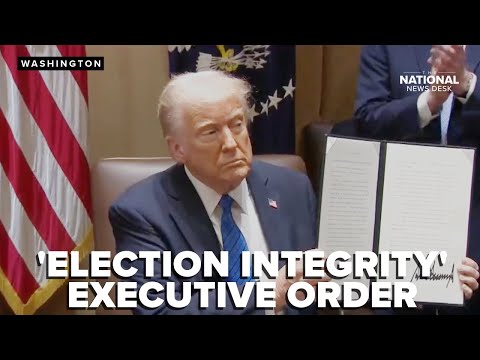
Trump’s order doesn’t stop there. It also threatens to withhold federal election funding from states that do not comply—an authoritarian tactic aimed at coercing local officials into complicity. And in a chilling development, the executive order empowers the Department of Homeland Security, now working with Elon Musk’s so-called Department of Government Efficiency, to scour state voter rolls using immigration databases. These tools were never designed for voter verification and pose a real risk of wrongfully identifying naturalized citizens for voter roll purges.
Legal experts and voting rights advocates are sounding the alarm. Richard Hasen, an election law scholar at UCLA, condemned the order as “an executive power grab” and “voter suppression pure and simple.” Colorado Secretary of State Jena Griswold called it flatly unlawful, warning that it aims to strip eligible Americans of their fundamental right to vote.
Despite these dangers, far-right groups like the Heritage Foundation predictably celebrated the move, seeing it as an opportunity to finally force through the voter suppression measures they’ve long desired.
If implemented, Trump’s order could dramatically alter election access across the country, giving federal agencies unprecedented influence over state-run elections—an area where federal control has historically been limited. And while Republicans claim it’s about “election security,” the timing and nature of the order make clear this is about one thing: rigging the system to benefit Trump and his allies at the expense of democratic participation.
In a final authoritarian flourish, Trump has even directed the Attorney General to crack down on states that count mail ballots received after Election Day—despite those votes being legally cast in many states with postmark requirements. It’s yet another effort to restrict how and when Americans can vote.
In sum, Trump’s executive order represents a dangerous escalation in the long-running assault on voting rights in America. Under the guise of fighting fraud, it weaponizes the federal government to suppress turnout and erode trust in the electoral system—all to benefit a man who refuses to admit he lost.