


For Vincent Morales, Jr., Fort Bend County is not just where he serves; it is also where he resides.
Since 2011, the former Mayor of Rosenberg and now Precinct One commissioner has built a career on the simple motto of leaving the county in a better place than he found it.
Business owner to public office

Morales’ path into public service began far from the Commissioners Court. After graduating from Spring Branch High School and attending the University of Houston, he started a landscape design company in 1978. The company is still running today, he said proudly, noting that his son, Justin, manages the business, while his wife, Regina, handles operations.
He had not planned to enter politics.
“I did not go looking for this. It found me,” he said.
In 2010, Rosenberg’s then-mayor approached him about running for mayor. Morales won, serving two terms as mayor.
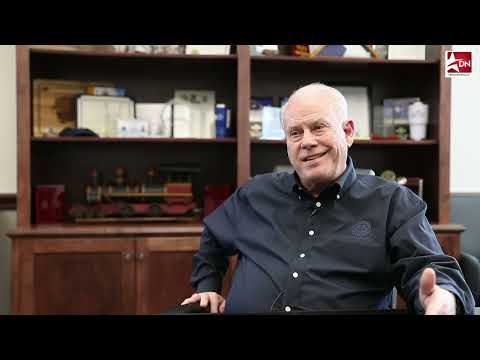
His proudest accomplishment remains the city’s cost-effective, long-term sustainable water plan, which he attributes to the partnership with the Brazosport Water Authority. He also worked with TxDOT to expand what was then U.S. 59 into today’s I-69.
“My passion and background are infrastructure,” Morales said. “To me, you have to have that for economic development, and it also improves quality of life.”
Managing explosive growth

Fort Bend is now one of the nation’s fastest-growing counties. Morales acknowledges both the opportunity and the strain. Projections once pegged Fort Bend’s population at 1 million by 2027, but Morales says it’ll happen sooner.
“We’ve got to be able to manage that growth,” he explained. “You’ve got to have the infrastructure to stay ahead of that as much as possible so that people can get from A to B in a reasonable amount of time and safely. What comes along with improved infrastructure is also public safety.”
He points to pedestrian safety as one area where his precinct has led.
“We are the first precinct to bring on HAWK signals (High-Intensity Activated Crosswalk),” he said. “We are always looking and working with engineering, the traffic engineer and others in the engineering department.”
A budgeting philosophy

Fort Bend’s rapid growth also puts pressure on its budget. This year, the Commissioners Court opted to hold the tax rate at $0.412 per $100 valuation, which is below both the no-new-revenue rate ($0.418) and the voter-approval rate ($0.429). Morales said that required caution.
“We’re actually not having any cuts in Precinct One,” Morales said. “We have been very careful to make sure that we stay within our means.”
When it comes to law enforcement raises, Morales said that a recent compensation study already brought deputies to competitive levels.
“If anyone checks my record, you’ll see that I’m very supportive of law enforcement,” he said. “We gave raises last year to bring people into a competitive environment. The sheriff did come to the podium during the budget hearings this year and said that he was able to fill the positions he had. We cannot continue to keep raising the salaries.”
Infrastructure and flooding

Morales often returns to infrastructure. Voters approved an $865 million mobility and parks bond in 2023, and while road projects are still in design, parks are advancing.
“Some of these are a little bit over budget, just because of inflationary costs,” he said. “That’s been our biggest struggle…trying to keep up with the inflationary costs. But as I said, we look for other resources that, instead of having to go back to the taxpayer for additional funds.”
He has also fought to secure outside funding, coordinating with TxDOT and the Houston-Galveston Area Council to secure $59 million for building Grand Parkway frontage roads, from FM 1093 to I-10 in Katy.
“We have a program manager staying on target, working with TDOT to make sure that we meet all criteria by August of next year so that we get that $59 million,” Morales said. “We were very fortunate to be awarded those dollars for the construction. This saved the taxpayers of Fort Bend County a tremendous amount of money.”
On flooding, Morales points to lessons since Harvey.
“Since Harvey, not only Precinct One, but the county as a whole, has improved due to our drainage department and flood mitigation,” Morales said. “If we had a Harvey, it would not be the same as it was back in ‘17.”
He warns, however, that erosion along the Brazos River remains a serious challenge, adding that 13 sites require erosion control to prevent the county from losing future property value.
Beyond roads and drainage, Morales has carved out a legacy in animal welfare. In 2018, he helped found Fort Bend Paws, a nonprofit organization that supports the county’s animal shelter.
His passion is deeply personal.
“The dogs that we’ve adopted, they’re rescues,” Morales said, who has grown up around dogs and has adopted a rescue. “There’s something special about a rescue that I just feel like they know that you’ve actually saved their life.”
A steady hand
In a polarized political climate, Morales keeps a steady demeanor.
“I don’t feel that it is a very good representation to publicly argue,” he said. “When I speak, it’s for a reason.”
Now in his third term, Morales insists his goals remain rooted in service. Looking ahead, Morales hopes his years in office will be measured not by partisan fights but by progress.
