During the grand finale at Houston’s IgboFest, a towering, spinning structure rises above the crowd.
It’s a moving temple of vibrant velvet tapestries, hundreds of intricately carved wooden figurines, and reflecting mirrors that catch the light, all swaying to the slow, heavy cadence of royal Akunechenyi drums from southeastern Nigeria.
That is the Ijele Masquerade, a nearly 13-foot spirit structure that Igbo tradition regards as the largest and most revered masquerade in its culture. On Oct. 24, the Ijele returns to Discovery Green as the featured performance of the 23rd annual Igbofest, a festival organized by the Ndi-Ichie Cultural Association of Houston.
Houston is home to the largest Nigerian population of any U.S. city, according to the Census Bureau, and Igbo residents make up a significant share of it. For 23 years, Ndi-Ichie has used Igbofest to keep that heritage alive for a generation of Igbo Americans raised far from southeastern Nigeria. Understanding why the Ijele matters so much starts with understanding what it is.
A tradition older than memory

The Ijele originated centuries ago in Anambra state, in communities near Aguleri and Umuleri, said Tim Ifemedebe, vice president of the Ndi-Ichie Cultural Association, who has studied the masquerade’s history. From there, it spread to neighboring towns, including Nteje, Ogbunike, and Awkuzu. In 2009, UNESCO inscribed the Ijele on its Representative List of the Intangible Cultural Heritage of Humanity, a recognition given to only a handful of Nigerian traditions.
In Igbo communities, the Ijele traditionally appears only at a community’s most significant events, historically marking the end of the dry season, celebrating an agricultural harvest, and honoring people of high social standing.
Obie Njoku, an anthropologist who teaches culture and religion at Emory University, said the tradition is so old that no one can date its origin. Scholars generally avoid the English word “masquerade,” Njoku said, preferring “masked spirit”, a distinction reflecting how central these figures are to Igbo cosmology rather than simple performance.
The name Ijele means soldier ant, Njoku said, a reference to the insect’s fearsome, unstoppable columns, reflecting the structure’s unmatched size among Igbo masked spirits. Traditionally, once it appears, no other masquerade performs afterward. In Igbo culture, a person wearing the Ijele masquerade is no longer seen as human; they are a vessel for the ancestral spirits (Eze Mmuo, the king of spirits).
BUILDING THE KING OF MASQUERADES
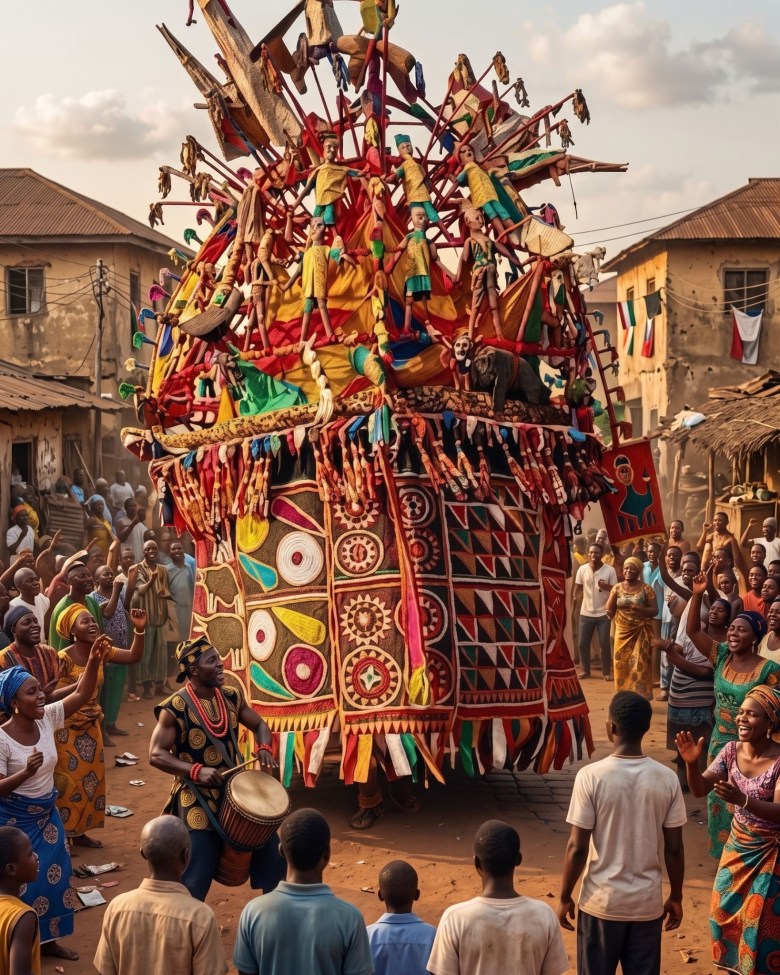
What audiences see in Houston represents a major logistical undertaking layered onto centuries of continuity. Building the Ijele traditionally requires around 100 people working close to six months, weaving bamboo frameworks and layering them with colorful fabric, mirrors, and small figures that each carry their own symbolism. To bring it to Houston, the structure is dismantled in Nigeria, shipped, and reassembled locally in a storage space tall enough to hold it upright.
“The person who carries and dances inside the frame must be physically capable of bearing its weight while turning to the beat,” Ifemedebe said. “A role that, along with the rituals performed before and after each appearance, the association keeps disclosed. It’s heavy to carry and to perform. And that is why it’s the greatest masquerade of them all.”
Connecting the diaspora

The Ijele’s arrival is set within a much older story. The movement of West African ritual and masking traditions across the Atlantic. Scholars of the diaspora have long traced connections between such traditions and practices that emerged during and after slavery, including the ring shout and funeral processions, and later, masked street traditions such as New Orleans’ Mardi Gras Indians and Caribbean Carnival’s Moko Jumbie stilt walkers. Each uses performance and craftsmanship to commune with ancestors and reclaim public space.
Njoku said that belief is inseparable from the Ijele’s existence.
“Nothing that happens in the physical world happens out of context,” he said. “There’s always a spiritual dimension.”
Masked spirits maintain a connection between the living and those who came before, a framework that echoes African American traditions rooted in ancestral memory and survival.
Keeping the culture alive
Ndi-Ichie, which means “elders” in Igbo, was formed to be a custodian of that heritage in Houston, said Fred Ogbutor, the association’s board chairman. Many of the community’s older members trace their history to Nigeria’s 1967-1970 civil war against the breakaway state of Biafra, a conflict that killed an estimated 1 million to 3 million people, mostly Igbo civilians, and scattered Igbo families around the world. Houston became one of their largest new homes.
Igbofest began in a community hall and moved to Discovery Green in 2019, becoming what Ogbutor calls a “destination festival” drawing performers and attendees from states including Minnesota, California, and Georgia. Its purpose is generational. Performers as young as 8 move through the festival’s youth pipeline, becoming volunteers around 18 and eventually organizers themselves. A companion, Ndi-Ichie Youth Cultural Foundation, runs a separate Igbo-language conference timed to the festival weekend.
“The way the culture is passed on may, over time, evolve to something not as pure as the original. But we are happy that there is a growing interest in Igbo culture here in the diaspora.”
Fred Ogbutor, Ndi-Ichie Association’s Board Chairman
Ogbutor acknowledged that culture carried across an ocean and generations does not always stay intact.
Younger Igbo Americans are using social media to spread interest in the traditions. That growth includes people with no connection to Nigeria at all. Ogbutor said one of the biggest effects of moving to Discovery Green has been introducing the Ijele to Houstonians outside the Igbo community, a widening circle he considers just as important as passing the tradition to Igbo children born in America.
“The way the culture is passed on may, over time, evolve to something not as pure as the original,” he said, adding that the association works to keep teaching what the traditions originally were. “But we are happy that there is a growing interest in Igbo culture here in the diaspora.”