Thirty-three years after seven Black artists pooled their money to buy a block of crumbling shotgun houses in the Third Ward, that block is hosting one of the most ambitious exhibitions in Project Row Houses’ history.
Project Row Houses (PRH) opens the Southern Survey Biennial III on Oct. 3, a nationally juried exhibition featuring six artists and one collective selected from more than 200 submissions across 13 Southern states. One artist will receive the $25,000 Tony Chase & Dina Alsowayal Prize, one of the largest awards of its kind for a Southern-based artist.

The exhibition, also known as PRH’s Artist Round 61, runs through Feb. 14, 2027. It is guest curated by Jessica Hong, chief curator at the Kemper Museum of Contemporary Art in Kansas City, Missouri, a departure from PRH’s usual practice of curating its rotating “Rounds” in-house.
Christelyn Nash, PRH’s programs and communications manager for public art, said the expanded scale is meant to connect emerging Southern artists with resources and a national audience.
“It’s just a great opportunity to showcase the artists that are working in the South,” she said. “We wanted to connect them with local folks and the resources to continue doing great work.”
A legacy built on ownership
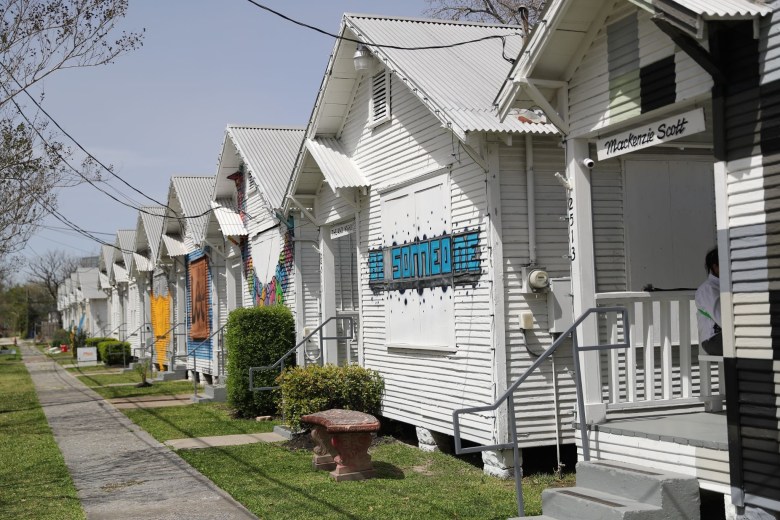
PRH was founded in 1993, when seven Black artists, James Bettison, Bert Long Jr., Jesse Lott, Rick Lowe, Floyd Newsum, Bert Samples, and George Smith, bought a block and a half of derelict shotgun houses at Holman and Live Oak streets. Rather than flip the property, they turned it into an artwork built from the community rather than canvas. The houses date to the late 1930s and were built by freed people, according to PRH.
“There’s a lot of deep ancestry in the houses, and artists are often inspired by the space itself,” Nash said. “They were built for multiple families, which is why they have such large porches.”
Today, PRH has grown from its original 22 houses to roughly 40 properties across five city blocks, even as Third Ward’s Black population has declined amid gentrification.
“Even through all the gentrification occurring within Third Ward, it’s good that Project Row Houses is still here and able to keep the history going,” Nash said. “It’s very important that this organization is in this neighborhood, keeping the history alive.”
Southern Stories, told from the inside

Every artist selected has a personal tie to the South, and each is transforming a historic row house into an installation centered on memory, family, and home, a response to how Southern artists are often stereotyped.
“Typically, artists in the South don’t get these types of opportunities,” Nash said. “The artists chosen are using a personal narrative to reshape how the South is being remembered and reimagined.”
Among them is Emmanuel Massillon, a Washington, D.C.-born conceptual artist working in painting, sculpture, performance, and sound. Though not from the Deep South, Massillon identifies as a Southerner through music, language, and community, tracing his hip-hop influences from D.C. to Louisiana.
His installation is dedicated to the late DJ Screw, the Houston producer who pioneered the “chopped and screwed” sound in the Third Ward in the 1990s, and incorporates found objects such as baseball caps and dirt, as well as a live DJ set at the opening.
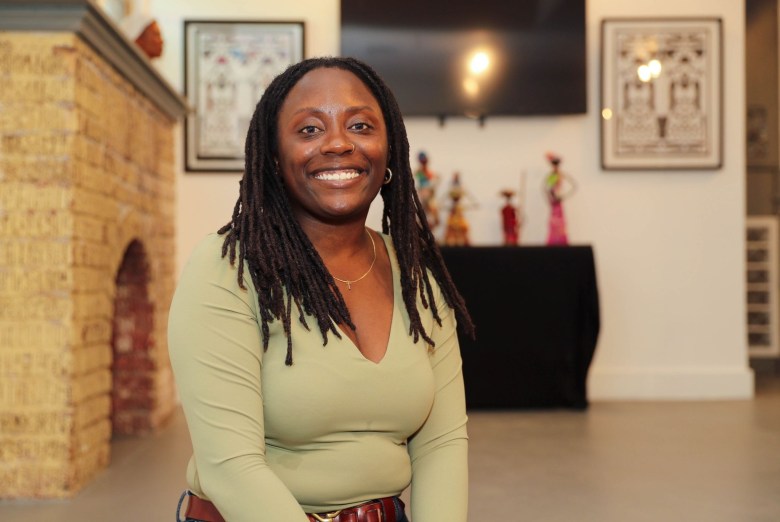
“Black Southern art has a very unique aesthetic,” Massillon said. “It comes from the history of the transatlantic slave trade, migration, and slavery, and I’ve been interested in preserving that legacy into the new generation.”
Houston-based photographer Jhanielle Brown, born in Jamaica and raised between Florida and Texas, is presenting Growing Home: Where Memory Takes Root, centered on Black women’s relationships with the gardens they tend.
“My installation is focused on Black women and gardening, and their relationship with the land when it comes to memories, culture, and historical significance,” Brown said. “A garden is a sacred space for Black women; it’s not just about growing vegetables, it’s therapeutic.”
Brown said Third Ward was the first neighborhood she explored after moving to Houston in 2017, and PRH was among the first places she visited, making her return for the biennial “a full-circle moment.”
Admission is free. Visitors are encouraged to RSVP at ProjectRowHouses.org.