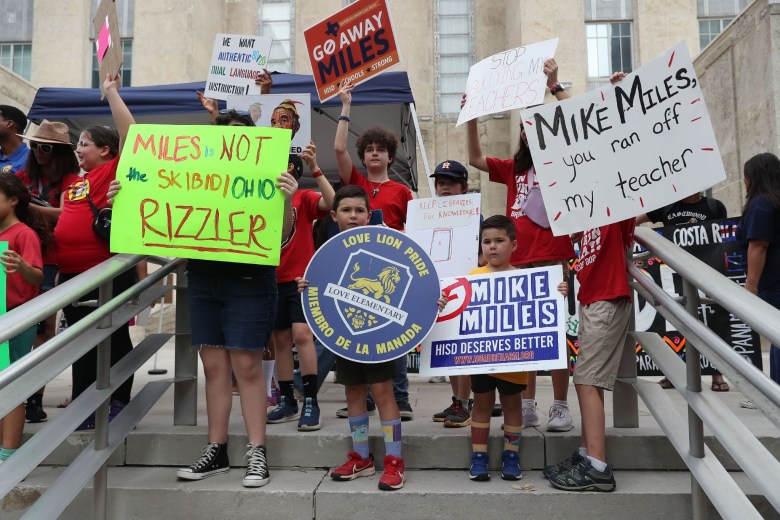
More than three years after the Texas Education Agency took control of Houston ISD, a commission comprising elected officials and academics says the takeover has weakened the district’s finances, driven educators out of classrooms, strained relationships with families, and stripped local communities of a voice in their schools.
In an 81-page report, the Commission on the HISD Takeover stated that the state-appointed Superintendent Mike Miles and his sweeping New Education System reforms “diminished, degraded, and destroyed” the school district.
Drawing on a year of public hearings and testimony from teachers (both current and former district employees and parents, the commission pointed to issues HISD is facing, exacerbated by an erosion of local oversight. It also called for legislative changes that would make state takeovers more difficult to initiate and give communities greater authority over when they end.
What did the report find?
The report focused on five findings, mainly:
- The state takeover “diminished” the curriculum: Per the report, HISD focused on test preparation over learning time, failed to make appropriate accommodations for special education students, and limited students’ access to libraries and books.
- A dismantling of relationships: The report claimed that HISD “severed bonds” among students, educators, and families. “This, in turn, eroded the relationships that sustain healthy school communities, which provoked profound grief and loss over schools that became unrecognizable,” the report reads.
- Demeaning educators: Referring to “intensive surveillance in classrooms,” the report claimed that teachers were subjected to degradation by HISD management and to an environment characterized by “fear and disrespect”.
- Destruction of democratic governance: The authors of the report observed that by installing a state-appointed superintendent and board of managers, the takeover removed local representation and, in turn, “meaningful opportunities for community engagement and constrained families’ influence over decisions affecting their children’s schools.”
- Degradation of HISD finances: Per the commission, the takeover led to “weakened financial controls”, including wasteful spending and unmonitored conflicts of interest.

“Schools have been closed, experienced teachers and administrators have been pushed out and unfairly fired, and the enrollment continues to drop,” said state rep. Lauren Ashley Simmons, who is also a co-chair within the commission, during a press conference on Oct. 8. “This takeover was never meant to cater to our kids.”
Simmons, whose children also attend HISD schools in Houston’s Third Ward, highlighted underinvestment in schools in Black and brown neighborhoods, citing the recent loss of Grimes Park in Sunnyside.
Alongside HISD, the TEA has expanded its intervention plans to four other school districts in the state: Beaumont, Connally, Fort Worth, and Lake Worth ISDs.
Moreover, based on the 2026 accountability ratings, Austin ISD is on the verge of a takeover.
Commission claims

Daniel Dawer, a Ph.D. candidate at the University of Texas at Austin, said the commission held three listening sessions last year, during which it aggregated testimony from HISD teachers and parents. He added that the number of teacher and principal removals, coupled with changes in access for families to their schools, removed the relationships that sustain healthy school communities.
“This erosion of the glue holding together community schools provoked profound feelings of grief and loss over schools that may have stayed open, but in many cases became unrecognizable,” Dawer said.
The observations on HISD comprise the most specific claims.
Miles asked the board in December 2024 to approve doubling the 2024-25 deficit from $125 million to $250 million, and it eventually reached $520 million, the report says.
The number of administrators earning more than $200,000 rose from 22 to 45.
The report says Miles spent over $97 million by March 2024 on furniture and equipment for NES schools, including adult-sized spin bikes that stayed in their boxes.
“For years, we’ve had Black and brown kids who attend schools with outdated or little to no resources.”
Lauren Ashley Simmons, Texas State Representative
It also cites roughly $870 million in purchase agreements that lacked board approval until the board approved them retroactively, and nearly $12 million in donations accepted the same way. Outside legal spending rose from $1.3 million in 2023 to $2.9 million in 2024 and and $2.6 million in 2025, after the superintendent gained authority to hire attorneys without board sign-off.
The report also revisits the failed $4.4 billion bond proposal of 2024, which voters rejected 60%-40%. It says the district spent more than $1.48 million on public relations around that campaign, and notes that the Texas attorney general’s office raised electioneering concerns.
What are the recommendations?

The commission recommends solutions for the school district as alternatives to Miles’ classroom reforms, including research-backed curricula that are not AI-dependent, reading books, access to libraries, and certified librarians in every school.
It also seeks to raise the threshold for triggering state interventions from five consecutive unacceptable accountability ratings at a single school to a pattern of underperformance at multiple schools in a school district.
In addition, the commission recommended a “partnership-based” intervention model in which local leaders do not lose their capacity to govern. It also limits the powers of state-appointed boards of managers and superintendents with clear guardrails on the extent of their authority.
Currently, Mike Morath, the TEA Commissioner, has the sole authority to determine whether a takeover should end. Instead, the power should rest in the hands of local leaders, the HISD commission recommends, through a referendum.
It adds that lawmakers should define the mandates for the commissioner’s powers regarding community engagement, and that state-appointed superintendents’ salaries should be paid by the state, not from local funding sources.
Miles, who is not currently a certified superintendent, was asked to seek certification. In June, HISD sought a certification waiver for him a year after it was required, allowing him to lead the school district without the required qualification.
“At present, the Texas Education Code sets no limits on the powers granted to appointed boards of managers and superintendents, enabling these unelected officials to impose changes that outlast their temporary appointment,” the report reads. “Lawmakers should codify clear guardrails that specify domains where appointed leadership has full, partial, or no authority, especially in regard to the discontinuing of academic programs, the sale of district property, and closing schools.”