Every summer, a group of Houston-area teenagers boards a bus before sunrise and spends a week retracing the roads of the Civil Rights Movement.
The Freedom Tour, an immersive week-long journey organized by the Expose Excellence Youth Program, takes students to the cities where Black Americans organized and reshaped the country: Selma, Tuskegee, Montgomery, and Birmingham, Alabama; Memphis, Tennessee; and New Orleans, Louisiana.

For BraShard Jackson, history came alive through the voices of people who endured it. The South Early College High School student listened to incarcerated people’s stories and encountered holographic representations of enslaved ancestors. It helped the senior follow a timeline of racial injustice at the Legacy Museum in Montgomery. The experience forced Jackson to reconsider how close the civil rights era is to the present.

“I learned that when people say ‘it wasn’t that long ago,’ they mean it,” Jackson said. “To go and talk to people who actually experienced and fought through segregation alongside these influential faces like Martin Luther King Jr. and Malcolm X just shows how much we have overcome, but there is still much for us to do.”
The Freedom Tour

This year’s trip expanded its reach through a partnership between Expose Excellence Youth Program, founded by Fort Bend County District Attorney Brian Middleton, and Harris County Precinct One Commissioner Rodney Ellis.
Since its founding in 2021, Expose Excellence has reached more than 2,000 students through mentoring, after-school programs, leadership academies, cultural activities, and career exposure. The organization began conducting the Freedom Tour in partnership with the YMCA of Greater Houston in 2023, taking roughly 30 to 40 students annually to civil rights sites.
The tour was funded through the Expose Excellence Youth Program’s nonprofit fundraising efforts. Additionally, this year, Ellis’ office provided approximately $37,500 to allow 15 Precinct One high school students to join the tour alongside participants from Fort Bend County.

The funding reflects a broader concern about who gets access to formative experiences during summer activities. A 2024 Gallup survey found that just 38% of children from households earning less than $50,000 participated in structured activities in 2023, compared with 67% of children from households earning $100,000 or more.
For Kyah Muhammad Howard, an 11th grader at Iowa Colony High School, the tour included “eye-opening experiences”, especially with Joyce O’Neal, a 78-year-old foot soldier who recounted her experience during the 1965 voting rights campaign in Selma.
Howard said O’Neal vividly described life before and after Bloody Sunday and shared memories of King and Malcolm X. Before the students left, O’Neal shared her wisdom on the importance of showing up to the polls.
“Before departing, Ms. O’Neal, with obvious emotion and vulnerability, looked each of us in the eye and expressed her fears that all of her hard work, blood, sweat, tears, trauma, and strength will go in vain because now people don’t even want to vote,” Howard said. “This wake-up moment shook me to the core. I now understand that it is imperative for my generation to continue the groundwork of the foot soldiers.”
During the tour, Howard also connected the lived experiences of Native Americans and African Americans.
“My spirit was moved as we watched a Mardi Gras performance. It was very insightful to learn the impact it had on our enslavement,” Howard added. “I learned how Native Americans, and their culture, are intricately woven into the fabric of African American history. There is truth to the saying ‘I have Indian in me!’”
Walking through history

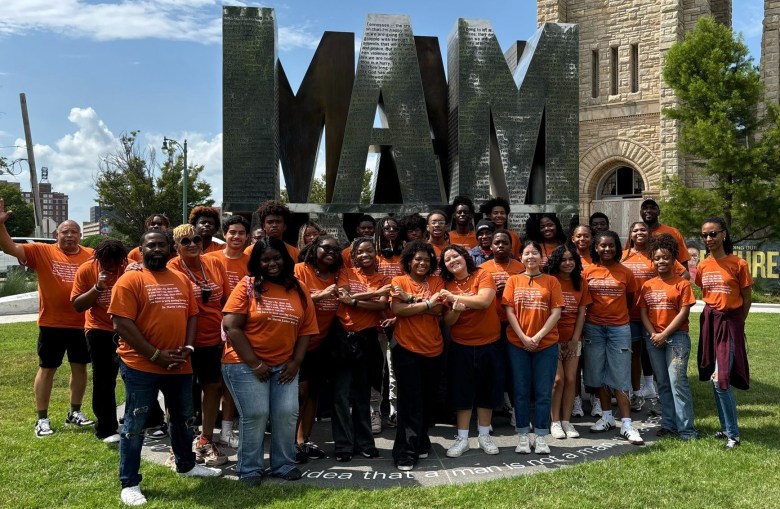
The distinction between reading history and physically entering formed the foundation of the tour.
At the Edmund Pettus Bridge, students walked where about 600 peaceful demonstrators attempted to begin a 54-mile march from Selma to Montgomery on March 7, 1965. Alabama state troopers and local law enforcement officers attacked them with clubs and tear gas in an assault that became known as Bloody Sunday. Televised images of the violence intensified national support for voting protections and helped propel the Voting Rights Act of 1965.
Brown Chapel AME Church, another stop on the tour, served as the marchers’ starting point and as a base for organizing during the Selma voting rights campaign.
The students also confronted the history of racial violence in Birmingham and Montgomery. Their destinations included the Birmingham Civil Rights Institute and the 16th Street Baptist Church in Birmingham, and the Legacy Museum, the National Museum for Peace & Justice, the Boat Ride on the Alabama River, and the Freedom Sculpture Park in Montgomery.
Other stops illuminated Black achievement alongside the history of oppression. At Tuskegee University, students learned about the legacies of educator Booker T. Washington and scientist George Washington Carver.
Howard also experienced a personal connection at Tuskegee, her mother’s alma mater, describing a walk through the campus for the first time as one of several moments that permanently changed her outlook.
“From marching across the bridge in Selma, to touring various historical museums, to walking my mother’s alma mater, Tuskegee University, for the first time, to the friendships that were formed, my outlook on life has forever been changed,” she said.
The tour paired each site visit with guided conversations and small-group discussions led by chaperones. The format encouraged students not only to process the pain contained in the history but also to consider what it demands of them today.
Keeping history alive
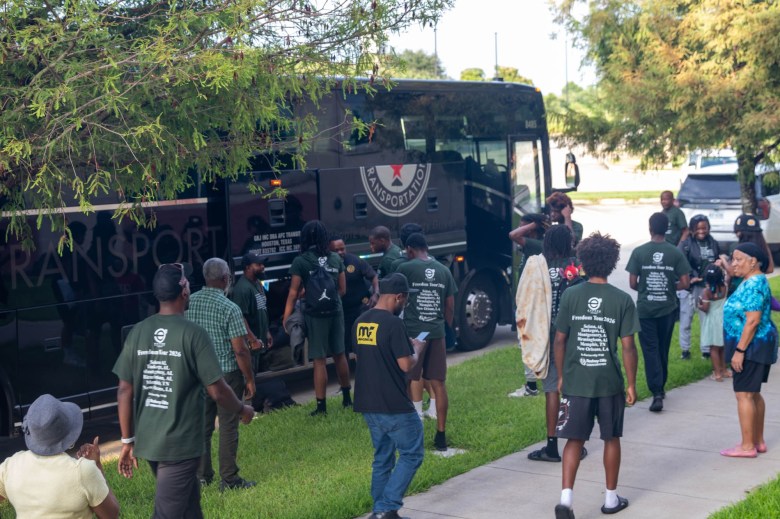
Ellis said that freedom is not something young people should only read about in a textbook, but that they should explore it in person.
“They deserve to stand where previous generations have organized, marched, sacrificed, and changed this country,” Ellis said. “The Freedom Tour helps students connect our history to their own leadership and civic voice. At a time when some are trying to erase or sanitize the truth, we have a responsibility to help young people learn it, carry it forward, and see themselves in the ongoing work to build a more fair and just Harris County.”
Middleton, Fort Bend County’s first Black district attorney, created the program to provide young people with enrichment and opportunities intended to keep them from entering the juvenile justice system.
“The Freedom Tour transcended the boundaries of a standard history lesson—it was a transformative crucible for leadership development,” Middleton said. “Tour participants did not merely study the past; they stood in the very rooms where history was forged and walked the hallowed ground of our nation’s civil rights pioneers. They marched with purpose across the Edmund Pettus Bridge in Selma, Alabama; stood in quiet reflection within the sanctuary of the 16th Street Baptist Church in Birmingham; and paid solemn tribute at the historic Lorraine Motel in Memphis, Tennessee.”
Middleton and investigators from the DA’s office traveled with the group. Middleton explained it was meant to encourage students to pursue careers in criminal justice.
“In a powerful, symbolic contrast to the oppression of the Jim Crow Era, the youth were escorted by law enforcement officials and officers,” he said. “This meaningful interaction served as a vital catalyst for discussion, highlighting the historic progress achieved within the justice system while inspiring the next generation to carry the torch forward.”
Immersed in museum exhibitions, the youth confronted raw images of the struggle and listened to poignant first-hand accounts from the movement’s architects, Middleton added.
Howard left with a similar conviction.
“Absorbing the words of Birmingham District Attorney Danny Carr, feeling the experiences of Joyce O’Neal, walking the hallowed grounds where Dr. King dreamed, touching the site where Ruby Bridges discovered her courage, knowing that Mother Rosa sat, has empowered me to expose excellence in my community by any means necessary!” Howard said.