On a sunny Texas morning, while many students hurry between classes, Malani Clark is more likely to be found standing quietly in a field, laptop balanced nearby, carefully measuring the carbon dioxide rising from the soil beneath her feet.
The work is meticulous, often invisible to passersby.
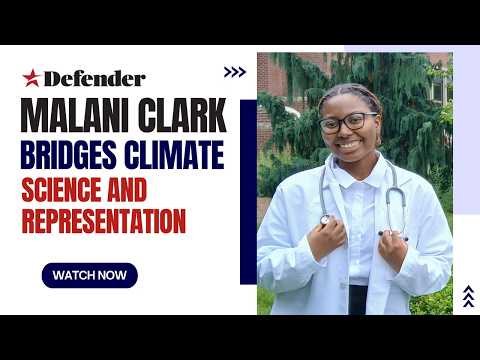
But for Clark, a senior agriculture major at Prairie View A&M University, those measurements tell a story about climate change, intertwined with food systems and the future of animal and human health.
Originally from Louisiana, Clark did not arrive at PVAMU with a neatly defined path into environmental science.


Her decision to attend an HBCU was shaped by conversations with her mother about the realities of veterinary medicine, where she will likely be one of the few Black women in her cohort.
Clark recalls her mother saying she has all her life to be a minority. She also advised Clark to join an HBCU so that she would not have to be self-conscious about being the only Black person in the room.
At PVAMU, change often starts in unexpected places, sometimes in a field and sometimes in a student discovering her voice as a scientist. For senior Melani L. Clark, undergraduate research has been more than a requirement.
— Prairie View A&M (@PVAMU) January 21, 2026
Read more here: https://t.co/dq12DZho0B pic.twitter.com/kYG8eGVOGd
According to a 2021 report by the Bureau of Labor Statistics, just 1.2% of veterinarians in the United States are Black, even though Black people make up 14.4% of the country’s population. Veterinary medicine remains one of the least racially diverse professions in the country.
In Houston, a city that is 23% Black, these numbers are even starker. Out of more than 1,024 licensed veterinarians in the Greater Houston area, only a handful are African American.
Having previously attended predominantly white schools and experienced microaggressions at a young age, Clark valued the chance to learn in a more diverse community.
At PVAMU and in Houston, she found a multicultural environment that allowed her to build relationships across races and cultures, which she believes made her more well-rounded.
The beginning
As a child, Clark gravitated toward science broadly, once imagining herself as an epidemiologist.
That trajectory shifted in high school after she transferred to a school with an agriculture program, where wildlife and animal science courses offered hands-on learning.
A veterinary practicum class, paired with certification as a veterinary assistant, helped her see how science could intersect with animal care in tangible ways.


By the time she enrolled at Prairie View, after briefly attending Houston City College, Clark knew she wanted a science-based career, even if she had not yet settled on exactly which discipline.
That clarity began to take shape after she enrolled in an agricultural economics course and met Dr. Ali Fares, who encouraged her to consider undergraduate research.
“Malani has consistently demonstrated an exceptional research work ethic; she is curious, committed and detail oriented,” said Fares, a professor of water security in the College of Agriculture and Human Sciences at PVAMU. “From her work on climate-smart practices and soil CO₂ emissions in grain sorghum systems to presenting at national and international conferences, she approached every task with professionalism and determination. Mentoring her has been a rewarding experience.”
Clark joined the Faculty Research and Innovation Success and Excellence (RISE) Program the summer after her freshman year, unsure whether she belonged in environmental science at all.
What she did have was curiosity and a willingness to learn.
For the past three years, Clark’s primary responsibility has been tracking soil carbon dioxide emissions in experimental crop plots.
Using soil flux chambers connected to sensors and a computer, she measures how different soil amendments, such as biochar and animal manure applied at varying rates, affect greenhouse gas emissions.
The goal is to identify more sustainable alternatives to conventional fertilizers without sacrificing crop productivity.
The technical demands of the research pushed Clark beyond fieldwork and into coding and lab chemistry.


That persistence paid off.
Clark’s findings were strong enough to be presented at national conferences, including the Association of 1890 Research Directors Conference in Nashville and the Emerging Researchers National Conference in Atlanta.
“Upon going into conferences, hearing about other scientists’ work made me realize, it’s a hard thing to do, but it’s manageable,” she said. “I’m smart enough to get this done and to be a scientist.”
What’s next for Clark?
Clark is focused on how agriculture contributes to climate change and how it might also help mitigate it.

By studying how reused animal waste affects emissions, she grapples with a tension at the center of sustainability: Practices that seem environmentally friendly but can still cause harm if mismanaged.
“We want to do great things, reuse animal waste, do sustainable stuff for animal production, and also recycle,” she said. “But we also want to make sure that the rates at which we’re doing it aren’t also posing a greater impact later.”
She plans to attend Purdue’s College of Veterinary Medicine in the fall of 2026, with an interest in livestock reproduction and nutrition.
Beyond that, she hopes to earn a master’s degree in public health and pursue work in food safety, government research, or regulatory oversight.
Raised in a family of educators, Clark also wants to return to the classroom, particularly in K-12 settings, to introduce young students to STEM fields.
Representation is central to her goal

Clark is aware of how few Black women occupy spaces like veterinary medicine and environmental science.
She hopes her own journey shows younger students that waiting for someone else to blaze a trail can mean waiting forever.
She, too, had moments of self-doubt.
“I would have never originally taken a research position because, especially being a woman of color, you think somebody is more qualified than me to do this,” she said. “I don’t think I’m as smart enough to do this. And I’d say, apply for it anyway, the worst thing that you can hear is no. Then if you do get it, be happy that you got it, but then also kind of be upset to where you thought, ‘I couldn’t do this.’”
As she prepares to graduate, Clark sees her undergraduate years as proof that she belongs in research spaces, where African American representation is sparse.
Only 1.2% of U.S. veterinarians are Black — and two Houston women are changing that. Dr. Adria Flowers & Dr. Cherese Sullivan opened Skyline Animal Hospital and are mentoring future vets to diversify the field.https://t.co/szLsh4aRg4 pic.twitter.com/Fn74ErWTV9
— Defender Network (@defendernetwork) October 21, 2025
“I hope that other Black girls and other women of color can look and see this is achievable,” she said. “If you want representation, you kind of have to be the advocate for that. If I waited as long as I did until I saw somebody like me do certain things, I’d be waiting for a really long time.”