Larry Callies didn’t plan to open a museum. But in 2017, he says God gave him a vision to create a space to preserve and showcase the legacy of Black cowboys.
He didn’t know why at the time. What he did know was that Black cowboy history was rarely, if ever, taught in his 1960s segregated school, where he lived in Hungerford, Texas.
“I’m a Christian first and a cowboy immediately after,” Callies says. “And I know when God closes one door, He’ll open a better one. He opened up this museum.”
His Black Cowboy Museum in Rosenberg, Texas, is now one of the only institutions in the country solely dedicated to this forgotten history. Through memorabilia, photographs and personal storytelling, Callies brings to life the legacy of the Black cowboy, a legacy often overshadowed, whitewashed or erased altogether.
Born and raised in El Campo, Texas, Callies rode horseback and roped cattle alongside his father, uncle and cousins. His father supplied stock for local rodeos and passed down his cowboy skills and values. But when schools integrated, Callies’ cowboy boots made him a target.
“When people think people oughta be a certain way, they make fun of them,” he says.
Still, he stayed true to who he was. As a young man, he entered rodeo competitions and, in 1971 became the second Black cowboy to reach the state finals in bareback riding, just a few years after his cousin, Tex Williams, made history as the first Black high school rodeo champion in Texas in 1967.

While Callies competed in rodeos, he dreamed of becoming a country singer like his idol Charley Pride. He eventually opened for music legends like Selena and performed for dignitaries including President George H.W. Bush and Governor Ann Richards. But just as he was preparing to record an album, a neurological condition, vocal dysphonia, silenced his voice.
“My voice gave out right when it was my time,” Callies says. “But when I lost my voice, God gave me another.”
A chance encounter with history
Callies was a postal worker who retired in 2011. He decided to put on his gear once more to work as a historical reenactor at George Ranch Historical Park on the outskirts of Houston. As he cleared the barn, he stumbled upon a photo from the 1880s showing seven Black cowboys on horseback. That moment shifted everything.
“That was the first proof I saw that cowboys like me weren’t just pretending,” he says. “We were the original.”
That image and his faith and deep pride in his heritage fueled the birth of the Black Cowboy Museum.
Today, Callies is not just the museum’s founder; he’s also its lead guide and historian. Thousands of visitors from across the nation, including busloads each week, come to hear his voice tell the stories that history books leave out.
There was a point in time when pop culture whitewashed the stories of Black cowboys.
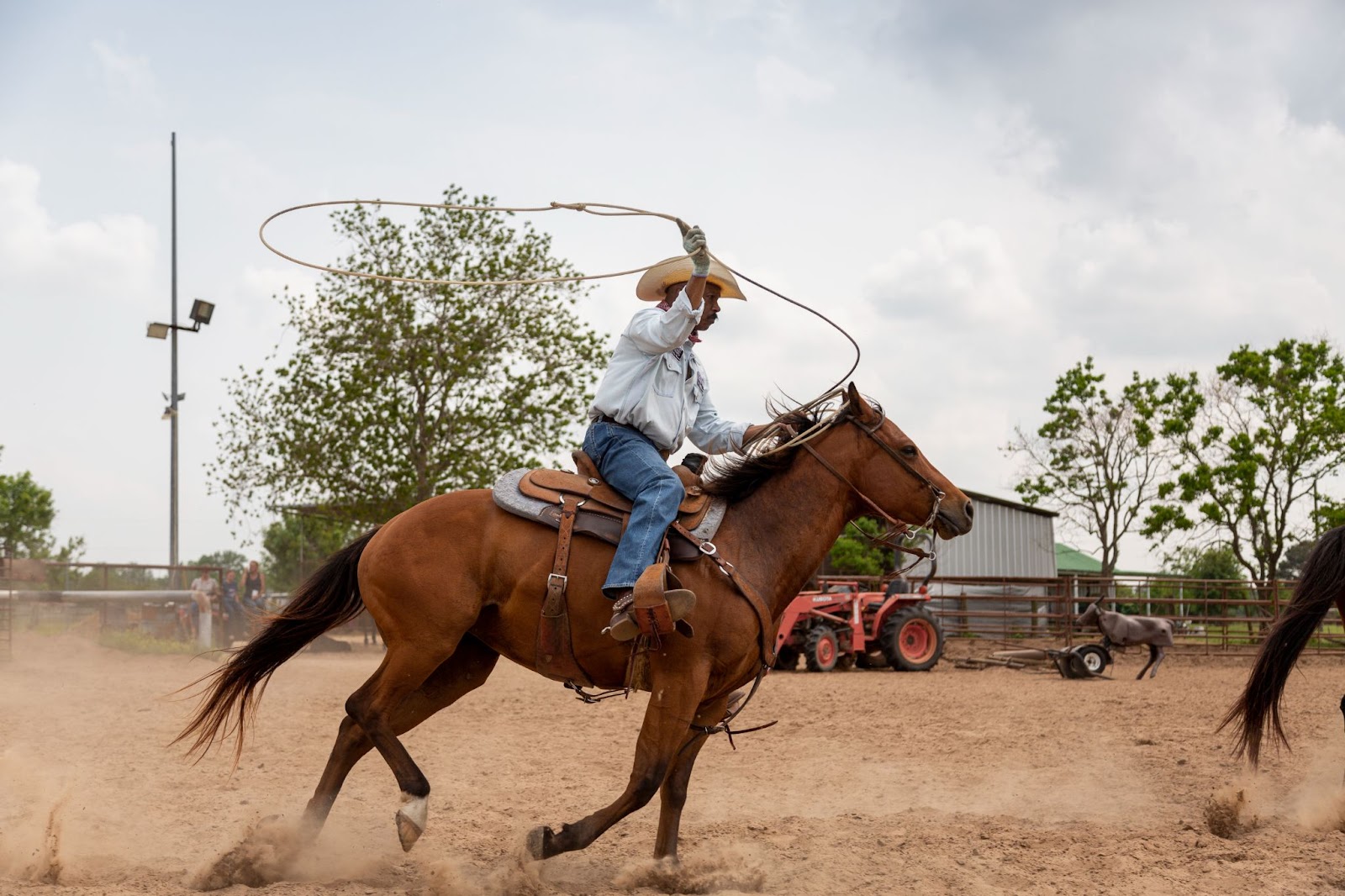
When you hear “cowboy,” you might associate it with Hollywood icons like John Wayne or Clint Eastwood, but historians suggest that one in four cowboys were Black. The Lone Ranger television series (1949) was inspired by African-American escaped slave Bass Reeves.
Many have invested interests in these stories, notably with features in the New York Times and season one of the Netflix documentary High on the Hog: How African American Cuisine Transformed America, episode titled Freedom.
With the return of cowboy culture in music, film and fashion, Callies’ work is vital to the culture. The “Yeehaw Agenda” is a movement coined by a young Black woman from Dallas, Bri Malandro, highlighting Black cowboys and cowgirls in popular culture. This is seen in the success of rapper Lil Nas X’s Uptown Road and Beyoncé’s Cowboy Carter album.
Aaron Murphy has served as the museum’s assistant, handling daily scheduling, coordinating tours and events and helping manage the back-office operations while serving as a guide himself.
Murphy’s journey into the world of Black cowboy history is one of revelation.
“When I first came to the museum, I thought I knew a little bit,” he said. “But after sitting in on Larry’s tours and taking notes for two weeks, I realized most of this history wasn’t taught anywhere.”
One point that struck him deeply was the origin of the term “cowboy.”
“I knew the term ‘boy’ was used derogatorily for Black men,” he explained. “But I didn’t know that ‘cowboy’ came from that same place. It was originally a term used to dehumanize enslaved people who herded cattle.”
Hollywood later whitewashed these stories, pushing Black cowboys out of the frame while elevating names like John Wayne and Hopalong Cassidy.
Murphy did his research to verify Callies’ points and found they were historically sound.
“It’s valid history, just whitewashed or completely removed from history books,” he said.
That realization fueled his passion for the museum’s mission. Artifacts at the museum are sourced mainly from the surrounding Southeast Texas community.
“People around here hold on to things for generations,” Murphy said. “When their grandkids find these items, they often donate them to the museum.”
The museum staff is currently inventorying these items, with plans to launch an online portal so that schools and researchers can access historical documents and photographs.
“Some school districts have blocked our material,” Murphy revealed. “Evidently, you’re no longer allowed to teach this kind of history. But we’re going to keep preserving it and sharing it, because it matters.”
The nonprofit museum, which generated $200,000 in revenue in 2022, is set to expand to a new 4,000-square-foot site in historic Bates M. Allen Park in Kendleton. Bates M. Allen Park houses two historical freedmen’s burial sites, Newman Chapel Cemetery and Oak Hill Cemetery.
One is the final resting place of former State Rep. Benjamin Franklin Williams, who became the first Black legislator in Texas and one of only 10 Black constitutional delegates during Reconstruction.
The project was to be completed in 2023, but changes in funding have delayed it.
“We’re hoping to get a grant somewhere else,” said. “These are the times we are in, but the show must go on.”