When people think of entrepreneurial success, they don’t often think of the word art. But for entrepreneur, real estate developer, urban historic preservationist and author Sajdah Wendy Muhammad, the art of business makes up half the success equation.
So, just what is the science of business? And even more interesting—what is the art of business?
Science of business

For Muhammad, author of The Art & Science of Business, the scientific side is straightforward.
“The science of business is going to take you as far as your intellectual capacity—your degree, your skill sets, your experience,” she said.
In other words, the science is measurable: Numbers, analytics, systems and data.
That’s something George Woodard, a marketing operations specialist with eLsqrd Media Group, knows well.
“Emotions alone won’t keep the lights on,” said Woodard. “The science is in the numbers—how many people actually have this problem? What proof do you have that your solution works? You need data on buyer behavior, market size and real pain points.
“No amount of passion can replace doing your homework on whether customers exist and if they’ll actually pay for what you’re selling.”
It’s the disciplined side of entrepreneurship—grounded in market research, metrics, and logic.
Art of Business
But for Muhammad, it’s the art that brings spirit, culture and creativity to business—and often takes it to the next level.
“The art of it is where you go into that supernatural space,” Muhammad explained. “It’s when you go viral and didn’t mean to. It’s when you play an instrument and think, ‘That song came out of nowhere.’
“It’s going that extra step—and that’s the place and space where Black people have always lived. We’ve just never owned and monetized it.”
Muhammad contends that the unquantifiable creative spark has long fueled innovation among African Americans.
“Since we were kidnapped and brought here to America, we’ve been inventing and figuring out how to do things more efficiently—expressing our natural artistic talents,” stated Muhammad. “But we didn’t own the patents, the copyrights or the trademarks. Now we’re in a world that hinges on our culture. It’s time to own and monetize that.”
Indeed, Black creativity drives modern culture, from music and fashion to social media and marketing.
“When you look at all the money made off pop culture, Black American culture is pivotal to the monetization of pop music and pop culture,” Muhammad said. “We continue to invent and reinvent. One of my messages is: It’s time for us to own and monetize that.”
Woodard agrees that business has an artistic side that connects to emotion and storytelling.
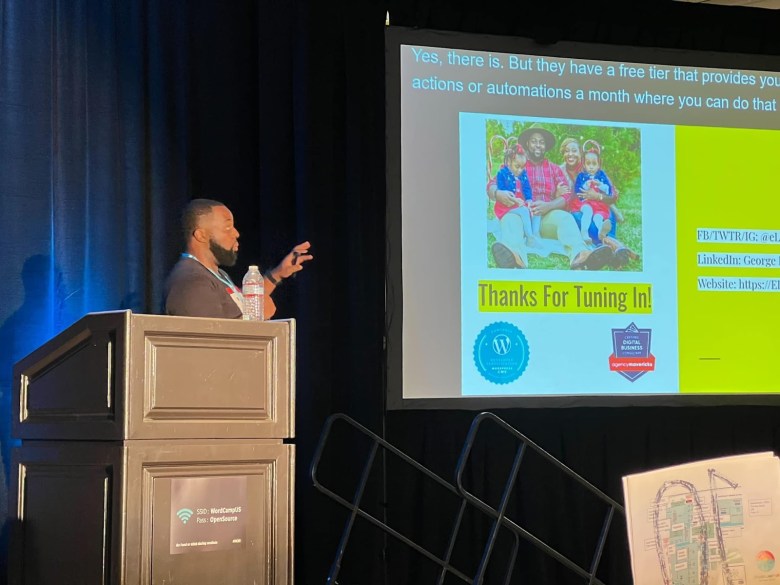
“Business is about capturing hearts before you capture credit cards,” he said. “Like any great story, you have to make people feel something—make them see themselves in what you’re offering. When you pull those emotional strings and connect them to your vision, that’s when attention turns into investment.
“It’s performance art with a purpose.”
The combination
Several Houston-area entrepreneurs have found success in blending the two.
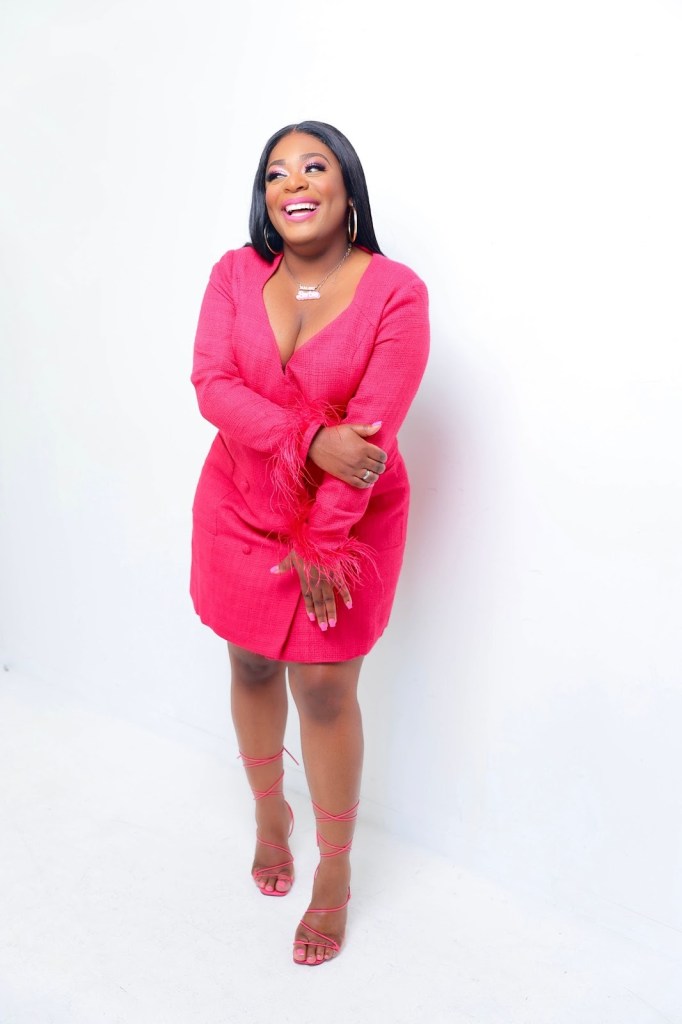
For event planner Taylor Ballard, the art and science of business are inextricably linked.
“Event planning is half art and half science,” Ballard said. “The art is in the creativity, design and emotion we bring to every celebration, while the science is in the strategy, logistics and precision that make it all come together flawlessly.
“Mastering that balance is what allows me to create with heart and still deliver the details with excellence.”
Christopher Winfield, founder of Forever Reel, learned this lesson the hard way.
“I started as an artist—a photographer and videographer who loved to create,” said Winfield. “But focusing on the creative side alone left me broke. It wasn’t until I began to focus on systems, structure, client management and marketing that I was able to turn a profit and leave my 9-to-5.”
Winfield sees business itself as a hybrid discipline.
“Business is an art form because no one can do what you can the way you can,” he said. “But it’s also a science—you must understand your niche, clients, systems and how to effectively reach them. One-hit wonders don’t last, and neither will your business if you don’t understand the process behind what works.”

Overcoming barriers
Muhammad believes one of the biggest obstacles for Black entrepreneurs is mental conditioning.
“We have so many talents and gifts,” she said, “but because of our colonization, we tend to reduce ourselves down to the one thing that makes us the most money.”
Muhammad recalls her own journey of integration and authenticity.
“When I was in corporate America, I used to call myself professionally schizophrenic,” Muhammad said. “I had all these different tracks that I was trying to juggle, and I was being a different person in each one. I’ve learned to be my authentic self—it’s all me, just expressed in different ways.”
Conscious entrepreneurship: The next evolution
Muhammad extends her ideas even further, calling for a shift from “predatory capitalism” to what she calls conscious entrepreneurship.
“The old standard business models were built on exploitation—somebody had to be preyed upon,” she said. “Those systems created what I call ‘economic genocide,’ pinching us off from the activities of life.”
Muhammad explained that conscious entrepreneurship is rooted in awareness and accountability.
“When you become conscious as an entrepreneur, you build a model where we don’t have to prey on one another,” she said. “We can be conscious of how we spend money and how our products and services impact our communities.”
Muhammad said the art of business is what naturally aligns with this model.
“If you’re a conscious entrepreneur and make a product, you want to make sure the waste from that product isn’t poisoning the water,” she said. “Predatory entrepreneurs only care about profit. Conscious ones care about people, purpose and planet.”
Book signing and networking event

To share her philosophy and inspire others, Queendom Come, Inc. will host a book signing and business networking event for Muhammad on October 11 at The Eldorado Ballroom (2310 Elgin St., Houston, TX 77004) from 4 p.m. to 6 p.m.
“With a history of building profitable ventures and global brands, Sis. Sajdah Wendy Muhammad embodies the fusion of faith and strategy,” said Attorney Sadiyah Karriem, founder of Queendom Come, Inc. “In The Art and Science of Business, she translates her lived success into a model for sustainable, spiritually aligned entrepreneurship.”
To register or purchase The Art & Science of Business, visit www.ArtandScienceofBusiness.com.