When Harris Health launched its race- and gender-conscious Minority- and Woman-owned Business Enterprise (M/WBE) program for locally funded contracts in September 2022, it did so amid glaring disparities.
In the fiscal years 2018 and 2019, Black-owned businesses received 0% of Harris Health’s total contract dollars. While the numbers have improved significantly in 2024, a closer look reveals that the road to equity is long, especially for Black vendors.
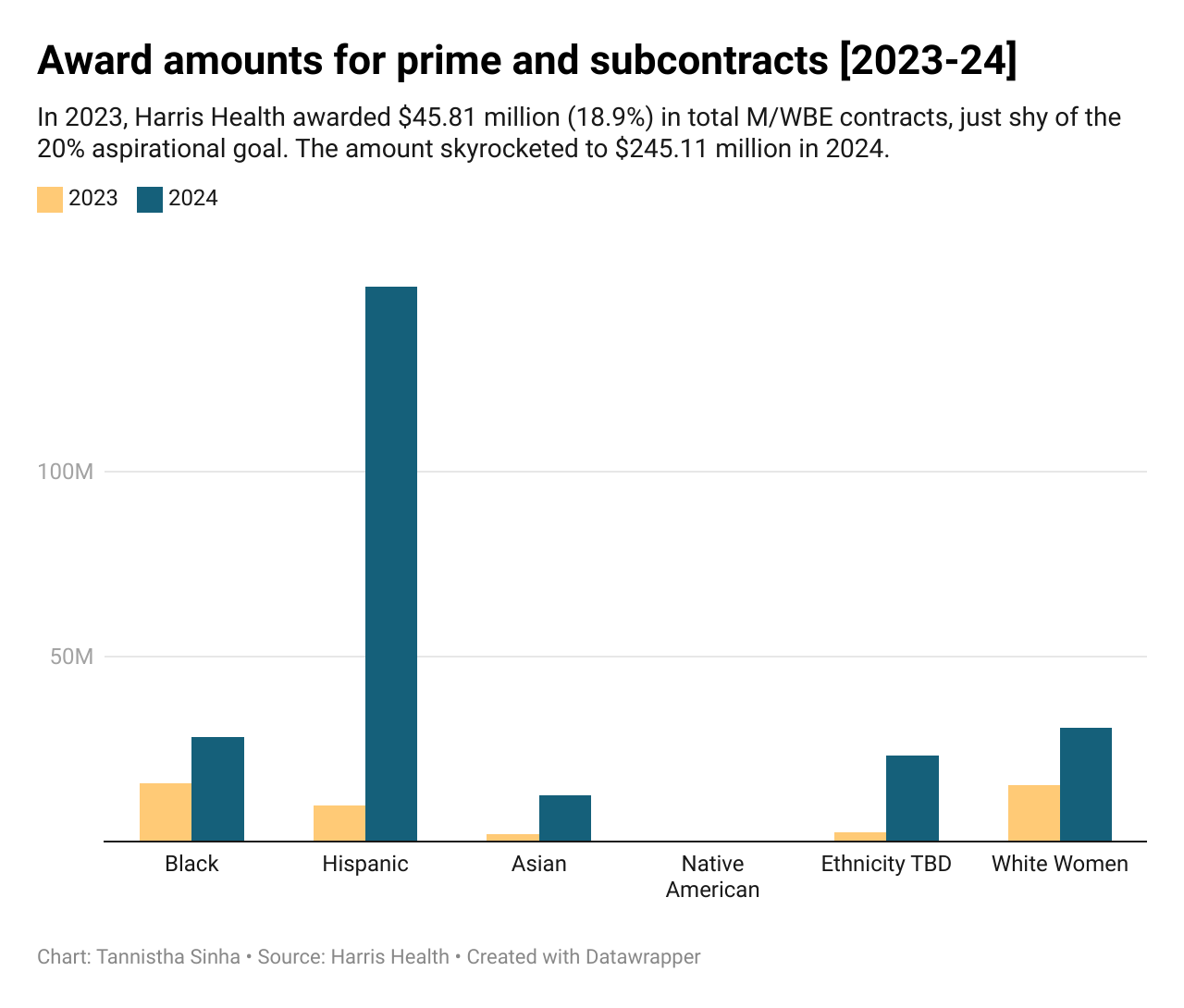
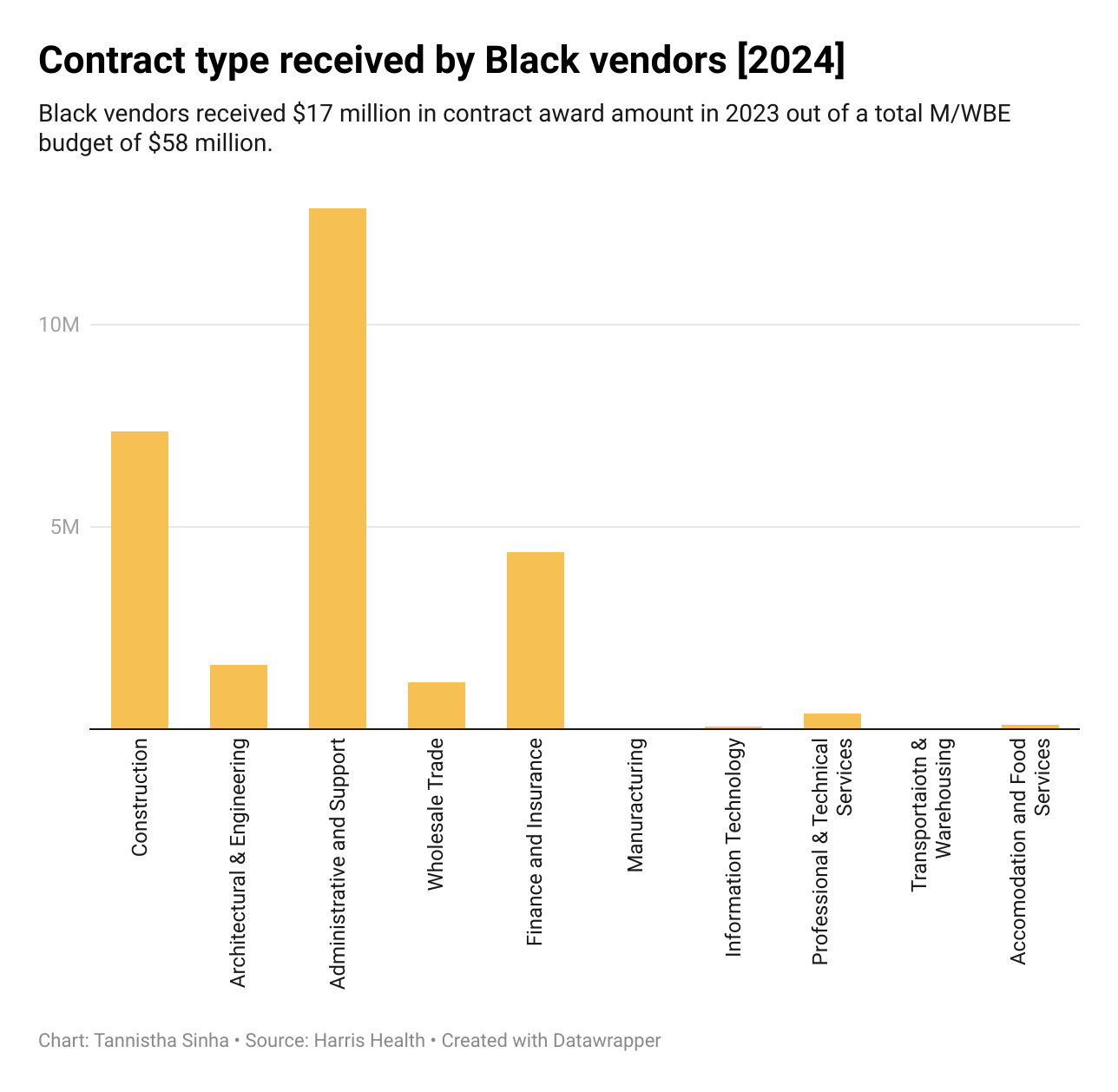
According to internal data obtained by the Houston Defender through a public information request, Harris Health awarded over $28.24 million to Black-owned businesses in 2024, or 35% of all MWBE dollars, more than any other group, nearly doubling the $15.94 million awarded in 2023. But despite the increase in the dollar amount, the percentage share of contracts to Black firms dropped from 6.6% in 2023 to just 3.44% in 2024.

“One thing that I’m actually proud of is even if you take the new hospital dollars out of our numbers, we still achieved almost 30% with M/WBE firms, which means we are spending with them in our everyday purchases,” said Derek Holmes, vice president of contract administration and diversity. “Even after this bond money [$2.5 Billion] is gone, we have systematically changed the culture here for the better.”
Outreach has grown, but so has the pool
In 2023, Harris Health awarded $45.81 million (18.9%) in total M/WBE contracts, just shy of the 20% aspirational goal. The amount skyrocketed to $245.11 million in 2024. The rapid ballooning of Harris Health’s M/WBE contracting budget is a testament to its growing traction in the market. Yet, Black vendors are still catching up in visibility and access.
Holmes, who develops and implements the M/WBE program, attributes it to the organization’s outreach and training initiatives and monitors the program’s progress to ensure adequate contract usage. In recent years, he has observed more people showing up to pre-bid meetings.
Hispanic-owned businesses made up the largest section of beneficiaries, with their share increasing from 4% or $9.7 million in 2023 to 18.26% or $149.88 million in 2024 in awarded contracts.
Meanwhile, white women-owned firms saw a decrease in their contract share, falling from 6.3% in 2023 to 3.74% in 2024. However, they gained in actual dollars, with their contract value doubling from $15.24 million to over $30.73 million.
Holmes said the team does not break down the applicant pool based on race or ethnicity. Instead, they do so after the prime contracts and subcontracts are chosen for reporting purposes.
“Once they bid, it’s up to the most qualified. If one ethnicity wins over another, that might not be reflective of the entire group,” Holmes explained. “There could be times where it looks like one may be winning over the other, but it could really just be that there’s a special firm or an outlier firm that is winning more.”
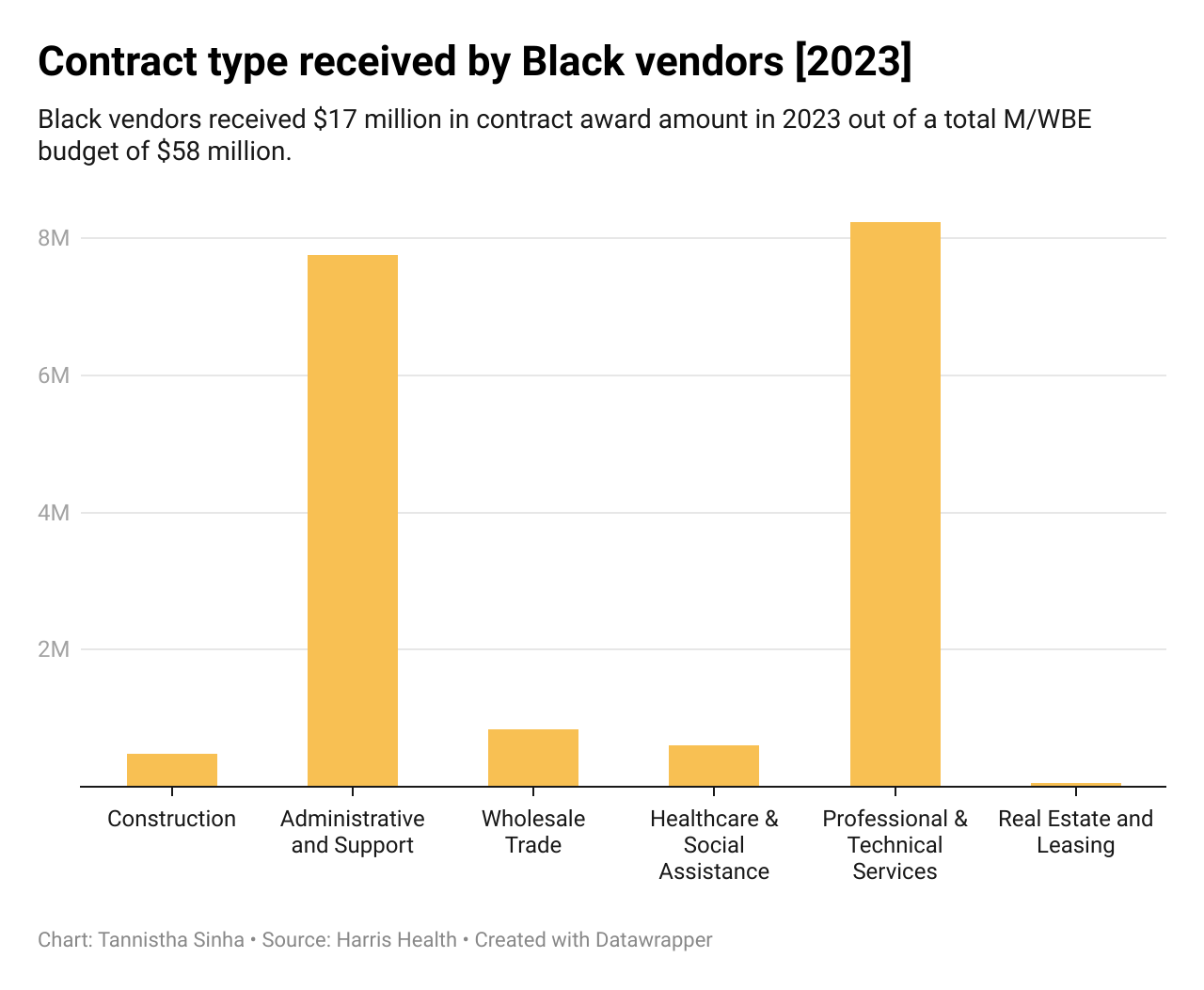
In FY 2023, Harris Health paid a total of $255.98 million to firms in construction, professional services and goods and services contracts. Of this, $17.67 million was distributed to M/WBE primes and subcontractors, or 7% of the average payment rate. The remaining 93% was awarded to non-MWBE contractors.
Other reasons behind the disparity
Holmes said the main challenge to equitable vendor contracts is not the market share a racial or ethnic group has, but the vendor selection culture. He explained that many prime contractors rely on a limited list of pre-vetted vendors, although Harris Health’s directory includes far more qualified firms.
“We just need to do a better job, as an agency, as a prime, as a M/WBE community, to make sure that we all know who is really out there and available to do work,” Holmes said.
Additionally, the overall pie grew almost five times, primarily because of construction contracts, where Black firms were underrepresented.
Building visibility
Consuela Floyd, Harris Health’s M/WBE contractor diversity manager, advised minority—and women-owned businesses to follow the agency’s social media platforms to check for upcoming events that could provide them with networking opportunities.
Floyd also emphasized the team’s focus on training and engagement through “coffee and conversations” on the third Monday of each month, training workshops and spreading the word about upcoming bids.
She pointed out the agency’s resources on how businesses can successfully submit a bid from start to finish through an online portal used for bid submittals.
“The main thing I would say is to make sure that they stay engaged,” Floyd added.
Beyond the dollar signs
The Contractor Diversity Program team explained that equity in contracting is not just about how much money is spent but also about who gets the opportunity and how often. They added that it is equally vital to monitor contract renewals, vendor performance and contracts for repeat awardees.
Holmes explained that contracts are typically awarded for one year with four optional renewals. He added that businesses can opt again for competitive bidding. This system helps prevent entrenched vendor relationships and ensures room for new players.
An ongoing journey
For now, Harris Health has no plans to change the structure of its equity program. Per Holmes, a new disparity study is due in 2027, while the team focuses on refining its outreach and internal accountability.
“We’re fighting for these firms. We’re out in the community encouraging them to come participate,” he added. “With any government entity, there are tight budgets in this economy and because of that, we do our best to try to have the biggest impact that we can. Every day, we try to help one more person or break down one more barrier.”