Despite a $500,000 pledge from the Texas Department of Transportation (TxDOT) to help artists relocate and rebuild, the loss of Houston’s iconic “Graffiti Park” still hits hard for the community that created it.
Many of the artists plan to take advantage of the funding, but they say what was destroyed can’t simply be replaced.
“This was an interactive piece. People came here for graduations, for weddings, for memories,” said Daniel Anguilu, one of the park’s original creators. “Sometimes you create things that you don’t know how they’ll take on a life of their own. That’s what this was.”
Now, the warehouse at 2011 Leeland Street—once covered in colorful murals of George Floyd, Selena Quintanilla and tributes to Houston’s rap scene—has been reduced to rubble as part of TxDOT’s I-45 expansion project. For many, it was a creative sanctuary and cultural landmark.


A plan for what’s next
Anguilu, who also runs the Harrisburg Art Museum, said he has submitted a proposal to TxDOT for a new initiative that would preserve Houston’s street art history while serving as an educational and cultural hub. But he stressed that any future project must include deeper collaboration with the artists who helped shape the city’s creative identity.
“I’m hopeful now that they know who I am, we can work together,” he said. “But we need local input. That can’t be skipped next time.”
TxDOT has confirmed it will allocate $500,000 to support future art and culture initiatives, though details on how that money will be distributed have not yet been finalized.
A cultural landmark lost

The Leeland Street building was part of Houston’s thriving street art scene for more than a decade. Created by Anguilu and two others, evolved into a global attraction, drawing tourists, photographers and fellow creatives from around the world.
Anguilu, who immigrated from Mexico City, was the first to paint the warehouse’s walls more than 12 years ago. His murals became known for their vibrant color, abstract shapes and powerful cultural themes. Over time, the building became a living canvas that honored Houston’s music legends, social justice movements and community pride.
“We didn’t have a place to paint,” he recalled. “We had a friend renting the building, and he gave us the opportunity. We started something that didn’t exist—and built culture around it.”
Artists speak out
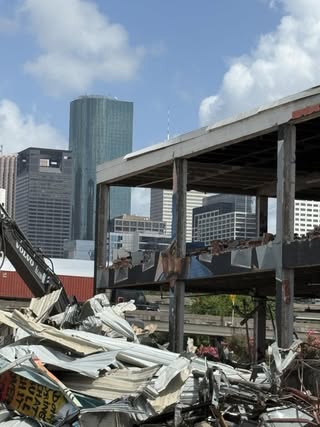
On social media, the reaction to the demolition was swift. Many shared memories, photos and expressions of grief, including Anguilu. He posted a message to Instagram calling the site “one of the largest and oldest art initiatives in Houston, purely run from artist to artist.”
“It has become a site visited by thousands,” he wrote, “and unfortunately, there was no conversation with us about the future or documentation of this iconic place for creativity.”
The site was also home to the widely recognized “Houston is Inspired” mural, created by artist GONZO247 in 2013. Commissioned as part of a national campaign to promote Houston as a cultural capital, it remains the most photographed mural in the city, according to Downtown Houston.
On Reddit, Houstonians mourned the loss.
“This is actually so tragic. A Houston staple,” one user wrote. “I used to love going to the hip-hop vintage flea market here. Felt like I was a true part of Houston.”
Another added, “The artwork was amazing. I wish some of it could’ve been preserved. Houston is fortunate to have such talented artists, and so many of their efforts should be around for years to come.”
A larger conversation
The I-45 expansion project, also known as the North Houston Highway Improvement Project, is expected to reshape major parts of the city’s landscape by realigning the freeway and removing dozens of structures in its path, which includes the building that housed Graffiti Park.
The loss of Graffiti Park comes shortly after the demolition of a Third Ward building that featured a mural of George Floyd, Black Lives Matter messaging and tributes to Sandra Bland and Breonna Taylor.
While some artists say they were caught off guard by the demolition, TxDOT maintains that notice was provided well in advance.
“We have always given community members advance notice of our intentions with the buildings and the property—even to the point of still allowing limited access as we addressed security concerns,” TxDOT said in a statement. “This was not months in the making but multiple years.”
The department added that it welcomes questions and aims to provide clear, accurate responses. “We want to be helpful for the story, but we want to be confident that the narrative is not directed by folks who continue to provide information that is not completely accurate.”
“I think we’ll eventually find somewhere else to paint our legends, but it doesn’t take away from the fact that it hurt the community. Those murals were like landmarks.”
Malyrik Musik
While TxDOT defends the I-45 project as necessary infrastructure development, artists and community advocates argue that Houston’s growth is coming at a steep cultural cost.
Malyrik Musik, founder of 7Th1rt3en Culture—a platform that documents Houston’s creative history—acknowledged the state’s gesture of support but said the damage has already been done.
“I don’t think it was ill-intended by the city because they offered $500K to artists to repaint elsewhere,” Musik said. “I think we’ll eventually find somewhere else to paint our legends, but it doesn’t take away from the fact that it hurt the community. Those murals were like landmarks.”