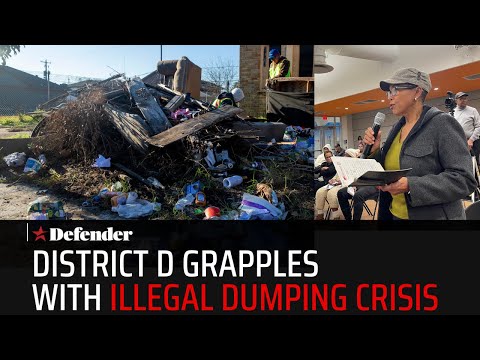
District D Council member Carolyn Evans-Shabazz is dealing with a persistent issue in her district—illegal dumping.
The problem exists when someone dumps waste, such as household trash, construction debris, old appliances and hazardous materials, on public and personal property without permission. District officials say it is a major contributor to the degradation of the district’s environment.

To tackle the problem, Evans-Shabazz said the district has its HOT (Homeless Outreach Team) team, comprising four people, two trucks and two trailers that also address illegal dumping.
She recommended her constituents call 311 to report incidents and ask to be transferred to District D with their service request number for a faster response to complaints. She also advised residents to “safely” take a photo of a license plate if they notice a car dumping trash in a neighborhood.

“I want somebody to be made an example of,” Evans-Shabazz said, adding illegal dumping makes up a significant portion of all waste produced in the Third Ward, Sunnyside and South Park. “Unfortunately, a lot of times, they don’t even live in the community, or they’re within blocks of their own home…a lot of times they are dumping that material on that road that leads to the legal dumping [site].”
Illegal dumping can result in citation charges or misdemeanors, which could result in fines of up to $10,000 for offenders.
What residents said
Shamika Martin, a contractor for the Texas Department of Family and Protective Services and resident of District D, said that in underserved communities in District D, where many families struggle to pay rent, utilities, child care and medication, combating illegal dumping is not one of their priorities, suggesting council members focus on community-based resources instead.
“We need to find a different mechanism in order to report illegal dumping,” Martin said. “Simply prosecuting someone in an underserving community where there is little to no resources is not a better solution.”
Martin said the Solid Waste department is “overworked and underappreciated,” and is understaffed to address the city’s demands. She suggested creating a volunteering program for high school students, providing incentives like gift cards to keep them motivated to support the existing HOT team.


Other residents said that despite calling 311 for a follow-up and providing their reference number, no action was taken. Some residents complained of 311 closing cases without resolving the issues.
“311 does not independently close cases,” said Paula Walker, senior trainer of the Administration and Regulatory Affairs Department at 311.
She explained the complaint process:
- A resident calls 3-1-1 to file a complaint
- A 3-1-1 operator asks residents for their contact information and creates a case after entering a service request
- The operator then submits it to the correct department
- The department then sends an inspector to investigate the case, who then creates a work order or resolves the case
Departments handle closures after investigations, though work orders may still be pending. Residents can track service requests online, while illegal dumping reports depend on property ownership and location-based classifications.
Prosecution of illegal dumping cases

Illegal dumping cases that reach the municipal court are conducted by a prosecutor, confirmed Hon. Oswald James Scott, Jr., Administrative Judge for the City of Houston. The judges “act as a referee in a case.” He explained that if a case goes to trial and a resident does not show up, the case gets dismissed.
Urging residents to report illegal dumping and provide evidence like photos and license plate numbers to assist prosecutions, Scott, Jr. said most residents do not come forward. He stressed that stopping illegal dumping requires community engagement.

“Everybody has a right to confront the accuser,” said Hon. Oswald James Scott, Jr., Administrative Judge for the City of Houston. “If you as a witness do not show up in court, that case is probably going to be dismissed. You may not want to be a rat, but if you don’t take the opportunity to come forward and face that person, then you are really not going to stop the problem.”
Mark Wilfalk, director of the Solid Waste Management Department, expressed concerns about the department’s undervaluation despite its critical role. He contrasted Houston’s solid waste budget of $100 million with Tampa’s $125 million budget, despite Houston being three times larger.
Last year, the department introduced an on-demand heavy trash pickup program to tackle illegal dumping, allowing residents to schedule pickups online. Wilfalk said Solid Waste employees would only pick up heavy trash once residents call for help, instead of driving around the city looking for trash to pick up.