

So much of our energy is tied up in the chaos of the present. Project 2025 and the flood of reactionary policies feel like a firehose designed to drown us in “What now?” despair.
But these victories for the far right didn’t happen overnight—they were decades in the making, rooted in long-term planning that stretches back to at least the Reagan era and even to Barry Goldwater’s 1964 campaign.
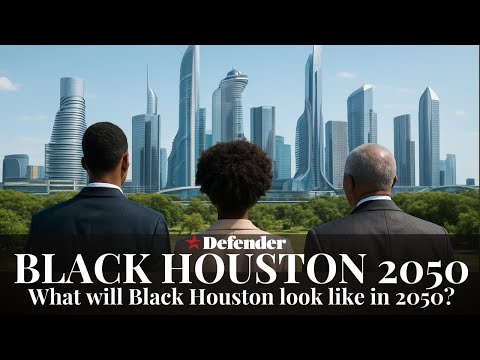
The lesson is clear: vision plus planning shapes the future. The question for us is—what is Black Houston’s vision of 2050? How do we want our communities to look in 25 years?

Demographers project that Texas’s population will nearly double between 2000 and 2050, with Harris County growing to almost eight million. The Houston region is projected to reach over 10 million residents. Black Houstonians—already the largest Black population in any state—are expected to double in size by 2050, increasing from roughly 500K to 1.1 million. This growth will shape politics, education, economics, health and culture in profound ways.
Political power
Carroll Robinson, former Houston City Councilman and TSU professor, sees continuity and expansion in political clout.

“Politically, we’ll still have the clout we have now, maybe even greater, especially as today’s young people age up.”
– Carroll Robinson
“The Black population in this state is projected to [reach roughly six million by 2050]. We’ll have both a large pocket of elder Black folks and a big pocket of young African Americans,” said Robinson. “Politically, we’ll still have the clout we have now, maybe even greater, especially as today’s young people age up. Even if we don’t have a majority in a district, Black voters will remain the decisive vote.”
JeVon Tone, a TSU graduate student and political organizer, envisions even more.

“Black voter turnout will be bigger in 2050 than now,” said Tone, head of the TSU Democrats. “I see Houston being a city with more employment, affordable housing, kids leaving high school with college degrees and a Black Houston politician running for president of the United States.”
Education & workforce

For Robinson, education remains the foundation.
“We’ve got to make sure not just Black students, but the entire system, is modernized for the innovation economy,” warned Robinson. “That means AI, blockchain, critical thinking—not just the old assembly line model.”
Dr. Reagan Flowers, founder of C-STEM, sees hopeful signs.
“To have this beautiful future for Black people in 2050, it all starts with education,” said Flowers. “I recently watched a young African American director in HISD who truly ‘gets it’—aligning STEM and project-based learning with the future of work. That gives me hope.”
She also points to new opportunities blending trades and tech.

“I know young people making $65,000 a year from drone licenses while in college. We’ll see more of that—new jobs we can’t even imagine yet, but for those skilled in problem-solving and creativity, the future is wide open.”
Economics & entrepreneurship
Robinson believes generational wealth transfers will reshape the economic landscape.
“Most of the wealth right now is in the hands of grandparents and parents,” said Robinson. “As that shifts down, younger Black entrepreneurs—who are already more entrepreneurial-minded—will do much more. I think you’ll see a much more prosperous Black America, even with roadblocks.”

The Arts & Afro-Latinx influence

Houston’s cultural future is equally bright. Raul O. Edwards, founder of the Foundation for Latin American Arts, calls this the “season of artistic liberation.”
“Funding organizations have reshaped the way they provide support,” said Edwards, the founder of Strictly Street Salsa, Houston’s first salsa studio. “Black and Afro-Latinx artists are no longer required to fit European aesthetics to get funding. Today, we see art in formats rooted in our own cultures. That will only increase in the future.”
Edwards also highlights the growing Afro-Latinx presence.
“For years, Afro-Latinx people had to identify as either Hispanic or African American. Now more are embracing the Afro-Latinx identity,” he shared. “This growth is inevitable and already enriching Houston’s cultural landscape.”
Community futures

Jaison Oliver, an educator, organizer and Afro-Futurist, offers a “tale of two cities.”
“If we don’t change course, by 2050 Black Houstonians in Third Ward and Fifth Ward will be pushed out to the suburbs, while investment flows into policing and jails,” said Oliver. “But if we move in the right direction, we’ll see hubs like RADO located in the Eldorado, community gardens, fresh food access, Riverside Hospital reopened, denser development, more public art and a stronger sense of resilience.”

Alicia Neal, executive director of the Emancipation Economic Development Council, emphasized the need for cultural preservation.
“We have to acknowledge, recognize and actively preserve our history and our culture,” said Neal. “Legacy entities like Jack Yates High School, celebrating 100 years soon, are important to our future. If we preserve what we have, Emancipation will look amazing—thriving businesses, retail, bookstores, restaurants and that front porch communal feel we love.”
Global & local challenges
By 2050, the U.S. will be “demographically blended,” with no single racial majority. Houston will remain one of the most diverse metros in the world. But climate change, automation and inequality loom large. Houston’s chronic flooding and extreme weather will test infrastructure. The challenge will be ensuring growth doesn’t come at the expense of Black communities.
Preparing for 2050: Steps for 2025
To create the future we want, Black Houstonians must act today. Here are key actions:
- Develop and share a collective vision—imagine Black Houston’s 2050, then plan for it.
- Prioritize education—demand investment in STEM, trades and critical thinking for Black youth.
- Expand political power—register, vote and support emerging young Black leaders.
- Build economic strength—buy Black, invest in Black businesses and prepare for generational wealth transfers.
- Preserve community spaces—fight displacement and use land trusts to keep legacy neighborhoods.
- Champion cultural identity—support Afro-Latinx, Black arts and heritage institutions.
- Protect our health—strengthen Black-led health initiatives and expand access.
- Plan for climate resilience—advocate for sustainable infrastructure and green energy in our neighborhoods.
