The discovery of a 29-year-old Black woman hanging from a tree behind a vacant house in Jackson has sparked grief, intense public scrutiny, and renewed conversations about the painful weight of history.
Authorities identified the woman as Tasia Fortune, whose body was discovered Aug. 3.
The Jackson Police Department is investigating the circumstances surrounding her death, while the Mississippi State Medical Examiner’s Office conducts an autopsy to determine the official cause and manner of death.
Investigators have not announced whether they suspect foul play or consider the death a suicide.
“History gives us examples. Black folks are not going to unquestionably accept suicide as a cause because we have learned over and over again that we cannot always trust official conclusions.”
Dr. Stacey Patton, Journalist & Author
That absence of clear answers has fueled rising concern among family members, local activists, and residents, many of whom point to the nation’s history of racial terror lynchings and decades of distrust surrounding law enforcement investigations involving Black victims.
“This isn’t just another death investigation,” Jackson City Councilman Kenneth Stokes told local media while requesting assistance from the U.S. Attorney’s Office. “Surely somebody should say something.”
The weight of historical trauma
The image of a Black body hanging from a tree carries a distinct, painful weight in American history.
Dr. Stacey Patton, a journalist and historian who has written extensively about racial violence, emphasized that acknowledging this history is critical—even while recognizing that suicide remains a reality within Black communities.
“I’m not going to participate in the myth that Black folks don’t commit suicide,” Patton said. “We do. Black men do. Black women do. Black children do.”
Federal data supports that reality. According to the Centers for Disease Control and Prevention, suicide rates among Black Americans have increased in recent years, with hanging or suffocation listed among the primary methods.
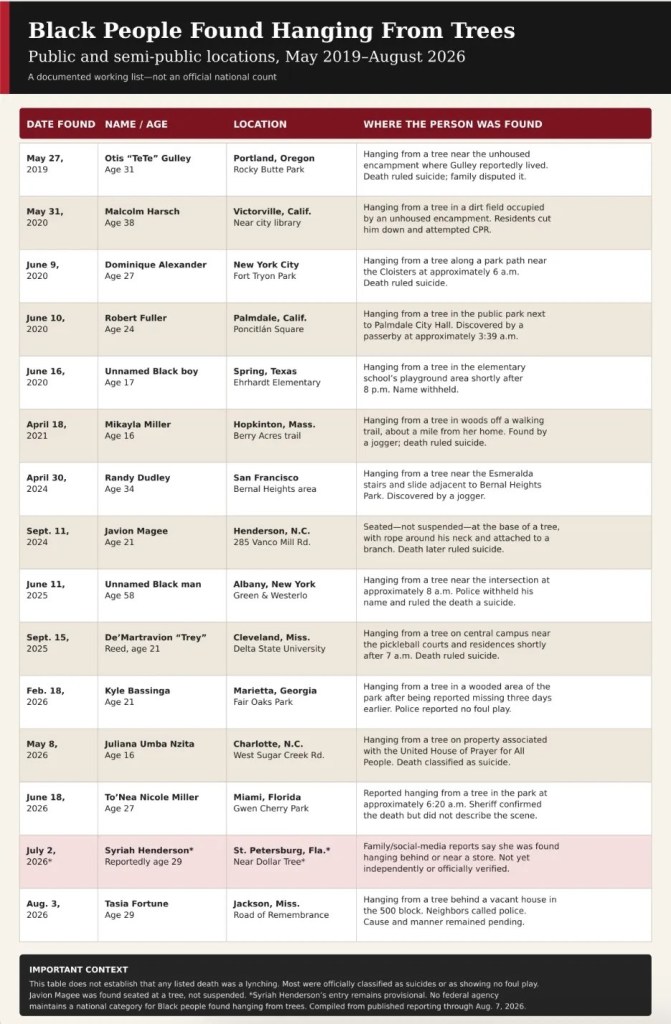
However, Patton argues that location plays a significant role in how these cases are viewed.
“Method is not setting,” Patton said in a Substack essay, noting that the vast majority of suicides occur inside private residences rather than public spaces. “A Black woman hanging herself inside a private home is not a tree beside a church, in a park, on a college campus, or behind a vacant house.”
While Patton stressed she cannot draw conclusions about any specific case without full forensic findings, she noted that discovering a Black person hanging outdoors naturally triggers deep public suspicion due to the nation’s past.
Why skepticism persists
According to Patton, community distrust is rooted in a documented record of official investigations failing Black victims.
She cited historic cases where deaths initially classified as suicides were later proved—or widely believed—to be lynchings:
- George Tompkins (1922): The 19-year-old Black man was found hanging from a tree in Indianapolis with his hands tied behind his back. Officials initially ruled it a suicide. Nearly 100 years later, historians and county officials officially recognized his death as a lynching.
- Shedrick Thompson (1932): A Black World War I veteran whose death was ruled a suicide despite physical evidence and historic consensus pointing to a racial lynching.
Those historical precedent cases continue to shape how many Black Americans view official law enforcement reports today.
“History gives us examples,” Patton said. “Black folks are not going to unquestionably accept suicide as a cause because we have learned over and over again that we cannot always trust official conclusions.”
Investigation ongoing
Authorities have released few details regarding the timeline or physical evidence found at the scene.
The Jackson Police Department stated detectives are actively following leads, while the Hinds County Coroner’s Office confirmed final autopsy results will provide the formal ruling.
Meanwhile, Fortune’s family has established a GoFundMe campaign to help cover funeral expenses, describing her as a “strong-minded, big-hearted, vibrant young woman.”
On the fundraiser page, the family shared a brief message reflecting both their grief and their hope for clarity: they believe “justice will be served.”