

Several candidates emerge when it comes to identifying the year that had the most profound impact on the lives of Black people in the U.S.
Pulitzer Prize-winning investigative reporter Nikole Hannah-Jones offered 1619 as the year of Black people’s beginnings in this land. The year 1865 marks the supposed official end to U.S. slavery. Then, there’s 1968, the year some historians contend everything in and about America changed.
But there’s a large contingent of Black people who argue no year impacted Black Americans more than the one that produced the Voting Rights Act, Bloody Sunday, the assassination of Malcolm X, the first Black Supreme Court Justice (Thurgood Marshall), the Watts Riots, Vietnam, and the first wave of Generation Xers.
That year was 1965, and according to many, its impact is still being felt some 60 years later.
Below are reflections on the big events of 1965 and their present-day reverberations.
Assassination of Malcolm (Feb. 21)

“When Malcolm X died, there were Black people who were happy that he died because they felt like he was interfering with what Dr. King was doing. They really could not see that, as my daddy used to always say, Malcolm X and Martin Luther King, they wanted the same thing – freedom. They just had different methodologies for achieving it. Malcolm’s was ‘By any means necessary.’ MLK’s was, ‘We’re gonna agitate, we’re gonna negotiate, we’re gonna litigate.’” (Pam Gaskin, League of Women Voters, executive board member)

“Malcolm is Black America’s prosecuting attorney. He’s prosecuting white America for a series of crimes against Black humanity that date back to racial slavery. Dr. King is Black America’s defense attorney… But over time, after Malcolm’s assassination, one of the biggest ironies and transformations is that King becomes Black America’s prosecuting attorney… They start to merge, especially in the aftermath of Malcolm’s assassination on Feb. 21, 1965.” (Peniel Joseph, founding director, LBJ School’s Center for the Study of Race and Democracy, UT Austin)

Impact in 2025
“The challenge [60] years after [Malcolm’s assassination] is to understand that… the force visited upon the body of Malcolm X in the Audubon Ballroom continues to disform Black Life… and continued unabated 1,000 miles or so south to the Lorraine Motel and has continued to weave its way through our world cutting down the next Breonna Taylor. And the beat goes on.” (Michael Sawyer, author and University of Pittsburgh African American Literature and Culture professor)
Bloody Sunday (March 7)

“1965. That’s the year of the Edmund Pettus Bridge. That’s the year that America saw itself in the faces of those police officers who beat those young people and older people on that bridge. All because they wanted to register to vote, which is a constitutionally guaranteed right of American citizens. (Pam Gaskin)

“When brothers and sisters went to march across the Edmund Pettus Bridge in Selma, Alabama, on the other side of the bridge were police and white vigilantes. They saw that and they marched across the bridge anyway, and they got beat pretty badly, men, women, and even teenagers. And that was shown around the world. It was very upsetting, of course, to Black people, but to a lot of white folks and a lot of people who believed in justice for all. So that was a very significant moment in the civil rights struggle.” (John Bunchy Crear)
Impact in 2025
“(Bloody Sunday) is still talked about today. There’s still an annual march across that bridge in remembrance of that Bloody Sunday. (John Bunchy Crear)
Selma to Montgomery marches (March 7 – 25)


“When we think about King, right after Malcolm’s assassination, King has what he later calls one of those ‘mountaintop moments.’ And he always says there are these mountaintop moments, but then you have to go back to the valley. And that mountaintop moment is going to be the Selma to Montgomery march, even though initially, when we think about March 7, 1965 — Bloody Sunday — demonstrators, including the late Congressman John Lewis, are battered by Alabama state troopers, non-violent demonstrators, peaceful demonstrators on the Edmund Pettus Bridge. (Peniel Joseph)
Impact in 2025
“Back in the day, all of the southern states argued that they had states’ rights, so they didn’t have to adhere to federal laws. That’s why federal troops had to come to colleges, high schools, and elementary schools, to insure the safety of Black students. This is the same thing going on today across the south and MAGA world, especially here in Texas and Florida. These right wing politicians, like Greg Abbott, fight against federal law. They’ll dictate to cities, take over HISD, dictate to universities, high schools, etc., that they can’t teach true history or use DEI in any way. That is a contradiction, but it was the same way in the past.” (John Bunchy Crear)
Voting rights (Aug 6)
INSERT YOUTUBE: https://www.youtube.com/watch?v=U4XtZ-tIzIA


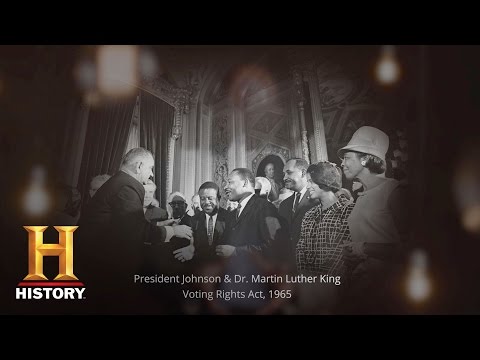
“In August, because folks got enraged about the Edmund Pettus Bridge, Lyndon Johnson used all his political capital or whatever he had left to sign the Voting Rights Act. And let me tell you something, that was momentous. And, we voted then; 90% of Black people used to vote. And things changed. All of a sudden, we started getting African American sheriffs, city council people, and representatives to Congress. Adam Clayton Powell was up in Congress. Let me tell you, we were making strides. 1965 was a year. And just think, the right to vote is so fundamental because voting touches every aspect of our lives. We went from being ‘done in’ to being doers. They were doing us. Now we get to do. We get to say who’s gonna represent me, or at least have a voice in it.” (Pam Gaskin)
Impact in 2025
“The Voting Rights Act and civil rights laws were passed to ensure equal opportunity in the 1960s are being systematically dismantled by the Executive and Judicial branches. DEI is the battle cry of the new Dixiecrats.” (Pam Gaskin)
Watts riots (Aug. 11 – 17)


“The year 1965 marks the 60th anniversary of the Watts revolt in LA, an ideological turning point in Black America. It also marks the passage of the Voting Rights Act in Congress, which too was (and is) profoundly significant even with its weakening of late by the courts. (Dr. Gerald Horne, UH professor and author)
“There was a brother that the police beat very badly. Rumor went out that he had died. When that rumor went out, all hell broke loose. I was 13 at the time, still living in Los Angeles. We lived in southwest Los Angeles and all hell broke loose. I mean, people start fighting with police, shooting at police, starting fires. There’s a misconception of the fires. People say, especially white folks, ‘They’re burning their own community.’ No. It was targeted, and it was targeted against businesses in the community that people felt, and they were right, exploited the community.” (John Bunchy Crear)

Impact in 2025
“White folks were like, ‘What the hell happened? We thought the Negroes were happy’ (re: the 1965 Watts riots). Just like today, there are people riding around in nice cars, living in nice houses. Well, we have a whole subculture of people who are suffering. Just like with George Floyd. The George Floyd protests weren’t just about George Floyd, they were about what was going on in the community.” (John Bunchy Crear)
Texas white primaries
“There was also the end of in Texas white primaries. See, Black people could not vote. Primaries used to be white, so only white people could vote in the primaries. That ended.” (Pam Gaskin)
DN: Learn of impact of Vietnam War then and now and downside of 1965.
