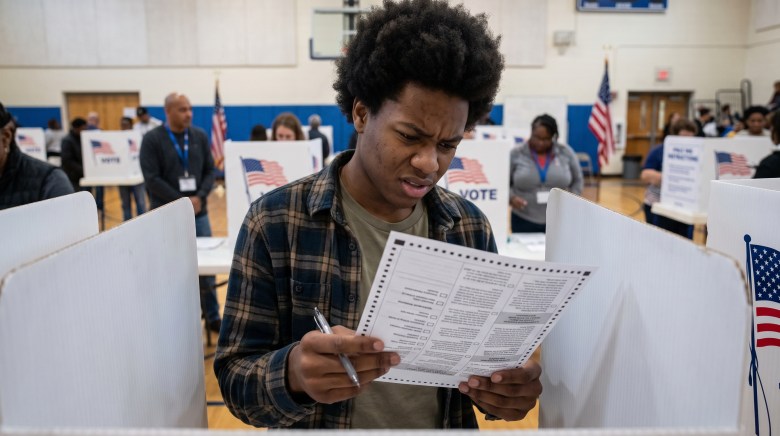
Zavion Addison remembers casting his first ballot in 2024 at the Shrine of the Black Madonna. Getting there was easy; however, understanding the ballot was not.
Addison, a 22-year-old Texas Southern University senior, had taken Texas and U.S. history courses but still got lost past the top race options.

“It’s a little confusing, especially if you don’t know much about politics at all and you’re a first-timer,” Addison said. “Do your homework before going in.”
Early voting for the Nov. 3 midterm runs Oct. 19-30, with races for governor, U.S. Senate, Congress, and an open Harris County judge seat, plus a Houston charter amendment on policing. Civic educators say young Black voters care about those issues, but ballot language often keeps them from the polls.

“It’s a little confusing, especially if you don’t know much about politics at all and you’re a first-timer,“
– Zavion Addison
No one in his family explained how government works, so Addison learned on his own.
“There was no one I could just go to and be like, ‘Hey, could you teach me more about this?’” he said. “It always had to come from my phone, truthfully, social media.”
He attends class full-time, works part-time, and pays rent without a car. He wants leaders to address homelessness and road construction that makes him late to class, but he does not know which offices control either. Those pressures pushed registering for this election down his list of priorities this year.
Midterminology

Journalist Joy Reid said voters like Addison are not to blame. The former MSNBC host recently brought The Joy Reid Show: Midterminology LIVE to Houston.
“They just want to get you out to vote, but they don’t say why or for what and what you’re going to get in return,” Reid said of political parties. “Voting is a transaction. You’re supposed to know what you’re getting.”
Reid saw the cost while working on Barack Obama’s campaign in Florida, where she said voters finished long ballots in 10 to 15 minutes and skipped races they did not recognize.
“That ballot in Florida was like eight pages long,” she said. “And there was so much on that ballot that people had no idea what was in it.”
A referendum or proposition, Reid said, lets voters make law directly instead of leaving it to politicians. Houston’s Proposition A, for example, would make misdemeanor marijuana possession the Houston Police Department’s lowest enforcement priority and ban no-knock warrants, with one yes or no vote covering both.
“Be careful, because sometimes they’re worded in a tricky way,” Reid said. “You think voting yes is yes and voting no is no, but it’s the opposite.”
Her other tip is for voters who, like Addison, learn politics from TikTok and social media.
“You have to be a good curator of the information that you’re allowing into your brain,” Reid said. “Before you believe what you’re reading, make sure that the person is credible.”
Learning the language
At the University of Houston, Jessica Ruland O’Connor teaches students to read that kind of ballot. The public policy lecturer and program director at the Hobby School of Public Affairs leads the Civic Engagement Boot Camp, where about 45 participants registered, asked questions, and practiced on voting machines.
“They just want to get you out to vote, but they don’t say why or for what and what you’re going to get in return.” Voting is a transaction. You’re supposed to know what you’re getting.”
Joy Reid, Host, The Joy Reid Show
“In Harris County, the county judge serves as the chief executive of county government rather than presiding over a traditional courtroom,” Ruland said in an email. “Another area that can be challenging is understanding ballot propositions and how proposed changes to laws or governing documents might affect communities.”
The county judge seat is open, with Democrat Letitia Plummer facing Republican Orlando Sanchez to replace Lina Hidalgo. The judge and four commissioners make up Commissioners Court, which sets the county budget.
Ruland said the fix starts with the problems students already face.
“If a student is concerned about flooding in their neighborhood, the condition of local roads, or access to public services, those concerns can be connected directly to decisions made by county government,” she said. “County commissioners help oversee important county services, infrastructure investments, and budget priorities.”
Many young people assume they can register entirely online, she said, but Texas requires most applicants to print, sign, and mail the form.
“One of the biggest challenges in voter education is that people don’t always know what they don’t know,” Ruland said. “Something as simple as misunderstanding a registration requirement or missing a deadline can prevent an otherwise eligible voter from participating in an election.”
Do your homework first

Sarah Rantala, a 19-year-old UH student, said her parents, including her father, a military veteran, always made voting a priority. A family move kept her from the March primary, so she will vote for the first time this fall.
During her time at the boot camp, Rantala saw a full sample ballot for the first time. She learned voters cannot use phones in the booth, but can bring a sample ballot marked at home.
“That’s why they strongly recommend that you at least have a plan, especially for the lower parts of the ballot,” Rantala said. “If you can’t do the whole sample ballot, at least fill out the last couple of pages.”
She also learned about the limited ballot for recent movers.
“Even if you’re registered in a different county, you can get a simplified ballot,” Rantala said. “So it’s not all of the local stuff and municipalities.”
It is offered only during early voting at the main early voting site.
She said young Black voters can close that gap by learning the system, as earlier generations did prior.
“There’s power in numbers,” Rantala said. “If we were to educate ourselves and stand up for something and actually push towards these resources, no matter how minuscule, we could actually make a change.”