


Where does the history of Blacks in space begin? It depends on who you ask and where you go to get your information. If you Google “the first Black in space,” you’ll see the name Guion Bluford, a Philadelphia-born brother who flew among the stars on Aug. 30, 1983. But three years prior (Sept. 18, 1980), the Soviet Union sent an Afro-Latinx Black man from Cuba into space. His name? Arnaldo Tamayo Mendez.
Others, however, argue that the Black presence in space accompanied those first, all-white, all-male NASA astronauts, who would not have been able to make the trip without those “Hidden Figures,” the hundreds of Black female math and science geniuses whose calculations created the roadmap to not only go to space, but get back home safely.
Still, others contend space travel wouldn’t be possible without the contributions of Ancient African societies, Kemet (ancient Egypt) and the Dogon people of Mali, West Africa, in particular, for giving the world the math and sciences upon which all civilizations have been built. But for the purpose of this article, we’ll stick with more contemporary history, beginning with the “Space Race” of the 1960s.
RACE FOR SPACE: US v USSR
The years 1960 – 1969 are marked as the period known as the “Space Race,” the competition between the US and the Soviet Union to claim the title of top technological power at a time when each nation was vying for an even bigger prize—position as the world’s preeminent superpower. Being the first country to “master” space was viewed as a symbolic victory in the overall “superpower” battle. And the winner could then sway the majority of countries on the planet to follow the top dog’s political, economic and social leads, while leaving the loser behind.
The Space Race, however, added another dimension to the overall battle—race. The award-winning documentary “Black in Space: Breaking the Color Barrier” put it this way:
“The Space Race, a battle between America and the Soviet Union to conquer the next frontier. But beyond the rocketry, the world’s two superpowers were engaged in another high-stakes competition: the race to put the first Black astronaut in space. To win, the United States would have to confront its ugly past.”
Thus, America’s legacy and 1960s current reality of unapologetic racism that kept its astronauts as white as the nation’s police forces, NLF quarterbacks and US Senators, would become a big “win” for its Cold War rival, the USSR, and by default, communism.
“The Soviet Union was able to point to the hypocrisy of the US government,” said Damion Thomas, curator of the National Museum of African American History and Culture. That hypocrisy was America’s claim to be the country offering “liberty and justice for all,” all while segregating and discriminating against Blacks legally and otherwise.
The White House literally ordered NASA to break up the all-white astronauts’ “club” in an effort to prove to the world America’s social and moral superiority. That push led to several Blacks who contributed to the Space Race in various capacities. Some of these are household names. Others may not be, but they contributed to the Black presence in space.
HIDDEN FIGURES (1960s – 80s)
Katherine Johnson (August 26, 1918—February 24, 2020) was a NASA mathematician whose calculations of orbital mechanics were essential to the success of America’s first and subsequent crewed spaceflights. As one of the first Black women to work as a NASA scientist, Johnson’s mastery of complex manual calculations helped pioneer the use of computers within the space agency. In recognition of her contributions as one of NASA’s unseen, yet heroic, “Hidden Figures,” Johnson was awarded both the Congressional Gold Medal and the Presidential Medal of Freedom, America’s highest civilian honors.

Mary W. Jackson, after successfully fighting Virginia’s segregation laws to attend night school, became NASA’s first Black female engineer in 1958. “She very well may have been the only Black female aeronautical engineer in the field” at the time,” NASA says. Eventually, Jackson became frustrated at her inability to break into management-level grades, NASA says, leaving engineering and taking a demotion to be Langley’s Federal Women’s Program Manager. Nonetheless, she “continued to influence the hiring and promotion of the next generation of NASA’s women mathematicians, engineers, and scientists.” In 2020, NASA honored Jackson by naming its Washington, D.C., headquarters building after her.
Dorothy Vaughn in the 1950s led Langley’s West Area Computing section under NASA’s predecessor — the National Advisory Committee for Aeronautics (NACA). As Hidden Figures dramatically illustrated, the section’s all-Black staff was originally required to use separate dining areas and bathrooms. According to NASA, it wasn’t until 1958—when NACA transitioned to NASA—that the agency put an end to its segregated facilities. When Vaughan joined NASA’s new racially and gender-diverse Analysis and Computation Division (ACD), she became an expert in the FORTRAN computer programming language. Before retiring in 1971, Vaughan also contributed to the highly successful Scout Launch Vehicle Program, which put nearly 100 satellites in orbit.

Robert Henry Lawrence, Jr. (October 2, 1935 – December 8, 1967) was a United States Air Force officer and the first Black American astronaut. Though he died in a flight training accident before he could fly in space, his experience as an Air Force test pilot greatly benefited NASA’s early crewed spaceflight program.
Dr. Harvey Washington Banks (February 7, 1923 – 1979) was an American astronomer and scientist who made history in 1961 when he became the first Black American scientist to earn a doctorate specifically in astronomy. His research contributed to advances in the field of astronomical spectroscopy, the use of light to study the properties of stars, planets, asteroids, and other celestial bodies. Banks also specialized in geodesy, the science of accurately measuring and understanding the Earth’s geometric shape, orientation in space, and gravity field. Many aspects of today’s Global Positioning System (GPS) technology are based on his work in geodesy.

Dr. Arthur Bertram Cuthbert Walker, II (August 24, 1936 – April 29, 2001) was a Black American solar physicist and educator who was instrumental in developing the x-ray and ultraviolet telescopes used to capture the first detailed photographs of the Sun’s outermost atmosphere, the corona, in 1987. Still widely used in cosmology and astrophysics today, the technologies Walker developed are used in NASA’s solar telescopes, and the fabrication of microchips.
Arnaldo Tamayo Mendez of Cuba is the first person of African heritage to fly in space. Mendez spent eight days aboard the Soviet Salyut-6 space station in 1980.
Guion Stewart Bluford, Jr. (born November 22, 1942) is an American aerospace engineer, retired U.S. Air Force fighter pilot, and former NASA astronaut who in 1983 became the first Black American to fly in space aboard space shuttle Challenger.

Michael P. Anderson (December 25, 1959 – February 1, 2003) was a U.S. Air Force officer and NASA astronaut who, along with six other crew members died in the space shuttle Columbia disaster. Having served as the Columbia’s payload commander and lieutenant officer in charge of science, Anderson was posthumously awarded the Congressional Space Medal of Honor, an award previously bestowed on U.S. astronauts including Neil Armstrong, John Glenn, and Alan Shepard.

Dr. Ronald E. McNair (October 21, 1950 – January 28, 1986) was a NASA astronaut and physicist who died along with the entire crew of seven in an explosion seconds after the launch of the space shuttle Challenger on January 28, 1986. Two years before the Challenger disaster, he had flown as a mission specialist on Challenger, becoming the second Black American to fly in space.
AFRICAN SCIENCE GENIUS (PRE-SPACE RACE)
Kemet (Ancient Egypt), according to some of the world’s most renowned historians (contemporary and ancient), ancient Egypt literally gave the world the contributions or religion, art, science and “civilization.” Many scholars view the dynamic within Kemet like Harlem during the New Negro Movement (aka Harlem Renaissance) that benefited from Black genius coming from all over America and the world to contribute to the movement. Evidence continues to be unearthed to suggest that same dynamic is what made Egypt the cradle of civilization, with contributions made by Africans from all parts of the continent.
The Dogon People of Mali are believed to have originated in ancient Egypt, though they have stories of traveling from the Mande kingdom. The Dogon did have knowledge for centuries that were, until Galileo and his telescope, unknown to the Western world. They identified Jupiter’s moons and Saturn’s rings and knew that the Sun was the center of our solar system. They have stories about the big bang and other astronomical events. They had awareness about an invisible companion star orbiting Sirius that was unidentified until 1970. It baffles scientists to this day that an ancient race had knowledge of solar systems that cannot be seen without the help of high-powered telescopes.
Benjamin Banneker (November 9, 1731 – October 19, 1806) was a free Black American mathematician, author, surveyor, landowner, and farmer heralded as the first Black astronomer in the United States. Utilizing his knowledge of astronomy and mathematics, he authored one of the first series of almanacs accurately predicting the positions of the Sun, the Moon, and the planets.

MODERN HIDDEN FIGURES

Charles F. Bolden Jr. (born August 1946) is a former Marine aviator and NASA astronaut who between 1968 and 1994 logged over 680 hours in space as a pilot and commander aboard space shuttles Columbia, Discovery, and Atlantis. In 2009, President Barack Obama appointed him as the first Black administrator of NASA. As NASA administrator Bolden oversaw the transition from the agency’s space shuttle missions to the current era of exploration focused on fully utilizing the International Space Station and creating advanced space and aeronautics technology.
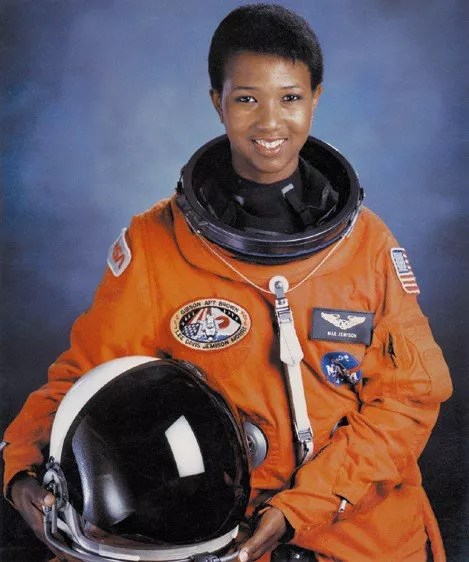
Dr. Mae Jemison (born October 17, 1956) is a physician and former NASA astronaut who, in 1987, became the first Black American woman admitted into NASA’s astronaut training program. On September 12, 1992, she became the first Black woman in space, serving as a medical specialist aboard space shuttle Endeavour. The holder of numerous honorary doctorate degrees, Jemison has been inducted into the National Women’s Hall of Fame, alongside luminaries such as Susan B. Anthony and Abigail Adams. She is also a member of the International Space Hall of Fame and holds the distinction of being the first real-life astronaut to appear on Star Trek: The Next Generation.
Frederick Gregory (born January 7, 1941) is a former U.S. Air Force pilot, NASA astronaut, and former NASA Deputy Administrator, who became the first Black American to pilot a space shuttle. Between 1985 and 1991, he logged more than 455 hours in space as the commander of three major space shuttle missions. Before working for NASA, Gregory was a highly decorated helicopter pilot during the Vietnam War.

Dr. Bernard Harris, Jr. (born June 26, 1956) is a physician and former NASA astronaut who in 1995 became the first Black American to walk in space during the second of his four space shuttle missions. Having logged over 438 hours while traveling over 7.2 million miles in space, Harris was awarded the NASA Award of Merit in 1996. Born in Temple, Texas, Harris is a UH alum.

Dr. Vanessa Wyche, NASA’s Johnson Space Center new leader, is the first Black woman to serve as director of any NASA center. However, she’s far from the first Black to contribute to America’s legacy of space exploration.
Dr. Neil deGrasse Tyson (born October 5, 1958) is an American astronomer, astrophysicist, and author known for presenting complex scientific concepts clearly and understandably. Through his many appearances on programs such as Public Broadcasting’s “’NOVA ScienceNOW,” Tyson encourages science education and the exploration of space. In 2004, President George W. Bush appointed Tyson to a select commission studying the future of the U.S. space program. The commission’s report, “Moon, Mars, and Beyond,” defined a new agenda for space exploration expressed as “A Renewed Spirit of Discovery.” In 2006, the director of NASA appointed Tyson to its prestigious Advisory Council.

Dr. Beth A. Brown (July 15, 1969 – October 5, 2008) was a NASA astrophysicist who specialized in the study of black holes and the emission of x-ray radiation from galaxies. In her work at NASA’s Goddard Space Flight Center, she championed science communications and higher education. After her premature death from a pulmonary embolism at age 39, the American Astronomical Society created the Beth Brown Memorial Award for outstanding minority science students, now presented at the annual meetings of the National Society of Black Physicists.

Leland Melvin (born February 15, 1964) is an American engineer and retired NASA astronaut who left a career as a professional football player to fly in space. Before retiring in 2014, he served aboard two space shuttle missions before being named NASA associate administrator for Education in October 2010.
Stephanie D. Wilson (born September 27, 1966) is an engineer and a NASA astronaut. The second Black woman to go into space, and a veteran of three spaceflights since 2006, her 42 days in space are the most logged by any Black astronaut, male or female.

Victor J. Glover made history in 2020 when he became the first Black crew member of an ISS Expedition to live on the International Space Station long term. On November 15, 2020, Glover flew onboard the first operational flight of SpaceX’s Crew Dragon. This was his first mission, and he lived on the ISS as a station systems flight engineer for Expeditions 64 and 65. He is one of only 14 Black Americans who have gone to space.
(Sources: Thought.com, Flyingmag.com, themarsgeneration.org and discoverafricanart.com)
