Prairie View A&M University has received a $9.9 million, five-year federal grant from the U.S. Department of War to expand artificial intelligence (AI) research for national defense and develop two new doctoral programs, one in computer science and one in mechanical engineering.
The award will be disbursed through the U.S. Army Materiel Command and will establish the “Center of Operational and Mission-driven Machine Learning for Advanced National Defense, Capacity Building, R1 Advancement, and Workforce Development for AI,” or COMMAND-AI. The university added that the funding will also be used to develop “the next generation of engineers and researchers to address national defense.”
The project is scheduled to run through July 2031.

“COMMAND-AI represents the kind of strategic investment that allows research capacity to move from momentum to scale,” said Dr. Magesh Rajan, vice president of research and innovation, and principal investigator for the initiative. “By bringing together faculty expertise, student talent, and advanced research infrastructure around mission-driven artificial intelligence, we can contribute solutions to national challenges while creating new pathways for discovery, doctoral education, and workforce development.”
In addition to Rajan, the effort will be led by Dr. Pamela Holland Obiomon, dean of the Roy G. Perry College of Engineering, and Dr. Noushin Ghaffari, associate professor of computer science.
What’s COMMAND-AI?
In response to the Defender’s query, PVAMU stated that COMMAND-AI will focus on three areas of research using AI, including additive manufacturing (typically referring to 3-D printing), advanced communications and cybersecurity.
The effort will build on the infrastructure the university already has.
According to the university, the federal fund bars the use of funds to purchase equipment or instrumentation or to renovate facilities.
“COMMAND AI builds upon research capabilities PVAMU has already developed,” PVAMU wrote in a statement.
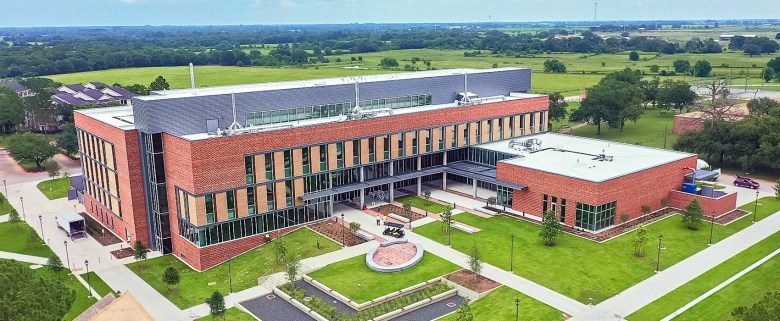
It pointed to a roughly $70 million Engineering Classroom and Research Building (ENCARB), which the university opened in June 2023, aiming to support work in AI and related fields. PVAMU also highlighted more than $140 million in research capability investments by the College of Engineering over the past decade.
“The Roy G. Perry College of Engineering has established goals to increase external research funding, double research expenditures, increase graduate enrollment, and double doctoral enrollment,” PVAMU wrote further. “COMMAND AI contributes directly to those goals by expanding research participation, doctoral education, faculty research productivity, and externally funded research.”
Additional programs

Per PVAMU, the $10 million grant will expand its undergraduate and graduate research opportunities, providing “stipend-supported research experiences” and creating a pipeline for those pursuing advanced degrees in AI and tech fields.
“We want undergraduate and graduate students to work alongside faculty across disciplines on high-impact, defense-relevant research,” Ghaffari said. “Our goal is to build a stronger pipeline of researchers and a collaborative research culture that will continue well beyond this five-year award.”
Researchers are expected to study areas including data fusion and predictive analytics, with potential applications in military communications and cybersecurity.
But a chunk of the fund will be used to develop two new doctoral programs at PVAMU, one in computer science and one in electrical engineering.
It has not been specified how many students the stipends will cover or how large they will be, or the amount that will go to faculty, research, students, and administration.
The R1 goal
Additionally, the fund aims to advance PVAMU’s goal of reaching R1 status. Currently, the university is classified as an R2 university, or a Doctoral University with High Research Activity. An R1 classification, or “Doctoral Universities: Very High Research Activity”, would mean reaching the highest rank of research universities in the country.
“This $9.9 million Department of War award represents a major milestone for Prairie View A&M University and demonstrates the power of true interdisciplinary collaboration.”
Dr. Pamela Holland Obiomon, dean of the Roy G. Perry College of Engineering
PVAMU’s Journey to Eminence Strategic Plan includes the attainment of more research activity, larger graduate and doctoral completions, more research faculty hires, and infrastructure to support its goals.
“The goal is for the research capacity developed through COMMAND AI to continue beyond the five-year award,” PVAMU stated. “COMMAND AI…will expand interdisciplinary research, create new opportunities for students and faculty, and strengthen PVAMU’s national research competitiveness in AI and advanced technologies.”
However, the university did not clearly state how much of the plan depends on the federal grant, nor did it specify how much it will contribute from institutional or state resources.
What happens after 2031?
Per PVAMU, the research capacity developed through COMMAND-AI will extend beyond the five years.
“The long-term strategy includes pursuing additional federal and industry research funding, developing sustained partnerships, integrating research into academic programs, and maintaining institutional investment,” per PVAMU.
To the Defender’s queries, the university also clarified that COMMAND-AI “is not a classified research program.”
“The federal solicitation specifically excludes classified research and describes the work as fundamental university research, with publication of research results expected to remain unrestricted to the maximum extent possible,” it added.