Texas is entering a new political era after voters delivered two stunning Democratic victories Tuesday, electing Gina Hinojosa governor and James Talarico to the U.S. Senate.
Their wins ended decades-long Republican streaks and raised a bigger question: How much will change in a state where conservatives still hold significant power?
Hinojosa defeated three-term Republican Gov. Greg Abbott, becoming Texas’ first Latina governor and the first Democrat elected to the office since Ann Richards won in 1990. Talarico defeated Republican Attorney General Ken Paxton, becoming the first Democrat to win a U.S. Senate election in Texas since 1988.
Together, the victories transformed what had long been considered reliably Republican territory into one of the nation’s most closely watched political battlegrounds.
Hinojosa’s unlikely upset
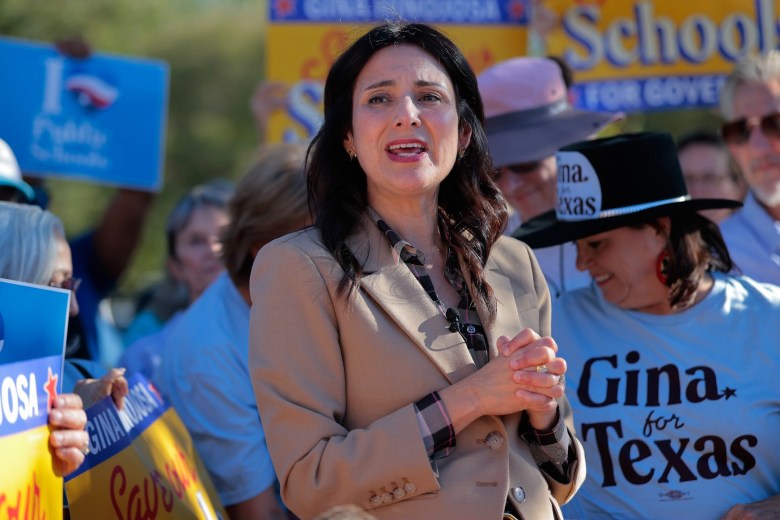
Hinojosa, a state representative from Austin, entered the race as an underdog against an incumbent with a formidable fundraising operation and a history of double-digit victories. Abbott sought a record fourth term, but a campaign built around economic frustration, public schools and concerns about the influence of wealthy donors helped Hinojosa reach voters beyond the Democratic base.
“It never bothered me that they doubted me. It bothered me that they doubted us.”
Gina Hinojosa
“We did it. Everything is bigger, including the shock of this win. We shocked the world tonight,” Hinojosa told supporters during her victory speech.
She added: “It never bothered me that they doubted me. It bothered me that they doubted us.”
The outcome carries immediate consequences for Austin. As governor, Hinojosa will be able to sign or veto legislation, appoint officials, and help set state priorities. She says one of her first orders of business will be to fire Texas Education Commissioner Mike Morath. But her victory does not give Democrats control of the Legislature. With Republicans retaining legislative majorities, her proposals will face negotiations and potential resistance.
Talarico ends a Senate drought

Talarico’s victory was no less striking. The Democratic state lawmaker defeated Paxton in a race that drew national attention and heavy outside spending. His win ends a 38-year stretch without a Democratic U.S. Senate victory in Texas and gives the party a new voice in Washington.
Talarico built his appeal around faith, political inclusion and economic concerns, while Paxton campaigned as a conservative ally of President Donald Trump. The result suggests that a coalition of Democratic voters, independents, and disaffected Republicans may be competitive statewide, though a single election alone cannot establish a lasting political realignment.
Historic turnout helps reshape Texas politics
The Democratic breakthroughs came amid extraordinary voter participation. More than 7.7 million Texans cast ballots during early voting, roughly 40.5% of registered voters, surpassing the state’s modern midterm early-voting record. That was before Election Day voters made their choices.
In Harris County, voters set a new midterm record. By 7:30 p.m. Tuesday, more than 1.39 million ballots had been cast, surpassing the approximately 1.22 million recorded in 2018. More than 1.08 million Harris County voters had already cast ballots before Election Day. Fort Bend County also recorded unusually strong early participation, with roughly 277,000 ballots cast by the close of early voting, according to an analysis of county voter rosters.
“These figures underscore the importance of investing in the mobilization of volunteers and voters, and in building lasting relationships with communities throughout Texas,” the Texas Democratic Party said in a statement.
The numbers reveal the intensity of an election that many Texans viewed as a referendum on affordability, public schools, state leadership, and national politics. But a record number of ballots is not the same as a record turnout percentage. Harris County has substantially more registered voters than it did in 2018, and final turnout rates will depend on certified results.
For Black communities in Houston, including Third Ward, Fifth Ward, Sunnyside and Acres Homes, the next question is how participation translated into influence. Precinct-level returns and demographic analysis will be needed to determine whether Black voter participation increased and which communities helped drive the statewide shift. The overall turnout figures alone cannot answer that question.
What is clear is that Hinojosa and Talarico benefited from an electorate larger and more engaged than in many previous midterms. Their challenge now is to turn that energy into governing results and keep those voters engaged beyond one election.