Texas is entering a new political era after voters delivered two stunning Democratic victories Tuesday, electing Gina Hinojosa governor and James Talarico to the U.S. Senate.
Their wins ended decades-long Republican streaks and raised a bigger question: How much will change in a state where conservatives still hold significant power?
Hinojosa defeated three-term Republican Gov. Greg Abbott, becoming Texas’ first Latina governor and the first Democrat elected to the office since Ann Richards won in 1990. Talarico defeated Republican Attorney General Ken Paxton, becoming the first Democrat to win a U.S. Senate election in Texas since 1988.
Together, the victories transformed what had long been considered reliably Republican territory into one of the nation’s most closely watched political battlegrounds.
Hinojosa’s unlikely upset
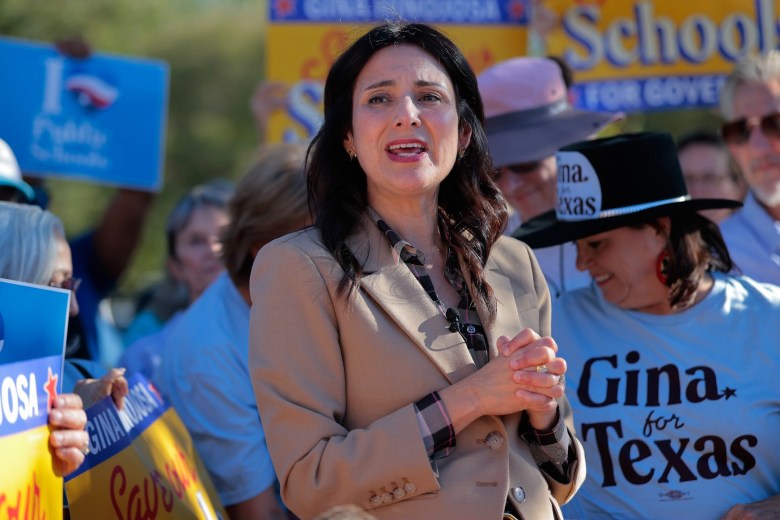
Hinojosa, a state representative from Austin, entered the race as an underdog against an incumbent with a formidable fundraising operation and a history of double-digit victories. Abbott sought a record fourth term, but a campaign built around economic frustration, public schools and concerns about the influence of wealthy donors helped Hinojosa reach voters beyond the Democratic base.
“It never bothered me that they doubted me. It bothered me that they doubted us.”
Gina Hinojosa
“We did it. Everything is bigger, including the shock of this win. We shocked the world tonight,” Hinojosa told supporters during her victory speech.
She added: “It never bothered me that they doubted me. It bothered me that they doubted us.”
The outcome carries immediate consequences for Austin. As governor, Hinojosa will be able to sign or veto legislation, appoint officials, and help set state priorities. She says one of her first orders of business will be to fire Texas Education Commissioner Mike Morath. But her victory does not give Democrats control of the Legislature. With Republicans retaining legislative majorities, her proposals will face negotiations and potential resistance.
Talarico ends a Senate drought

Talarico’s victory was no less striking. The Democratic state lawmaker defeated Paxton in a race that drew national attention and heavy outside spending. His win ends a 38-year stretch without a Democratic U.S. Senate victory in Texas and gives the party a new voice in Washington.
Talarico built his appeal around faith, political inclusion and economic concerns, while Paxton campaigned as a conservative ally of President Donald Trump. The result suggests that a coalition of Democratic voters, independents, and disaffected Republicans may be competitive statewide, though a single election alone cannot establish a lasting political realignment.
Historic turnout helps reshape Texas politics
The Democratic breakthroughs came amid extraordinary voter participation. More than 7.7 million Texans cast ballots during early voting, roughly 40.5% of registered voters, surpassing the state’s modern midterm early-voting record. That was before Election Day voters made their choices.
In Harris County, voters set a new midterm record. By 7:30 p.m. Tuesday, more than 1.39 million ballots had been cast, surpassing the approximately 1.22 million recorded in 2018. More than 1.08 million Harris County voters had already cast ballots before Election Day. Fort Bend County also recorded unusually strong early participation, with roughly 277,000 ballots cast by the close of early voting, according to an analysis of county voter rosters.
“These figures underscore the importance of investing in the mobilization of volunteers and voters, and in building lasting relationships with communities throughout Texas,” the Texas Democratic Party said in a statement.
The numbers reveal the intensity of an election that many Texans viewed as a referendum on affordability, public schools, state leadership, and national politics. But a record number of ballots is not the same as a record turnout percentage. Harris County has substantially more registered voters than it did in 2018, and final turnout rates will depend on certified results.
For Black communities in Houston, including Third Ward, Fifth Ward, Sunnyside and Acres Homes, the next question is how participation translated into influence. Precinct-level returns and demographic analysis will be needed to determine whether Black voter participation increased and which communities helped drive the statewide shift. The overall turnout figures alone cannot answer that question.
What is clear is that Hinojosa and Talarico benefited from an electorate larger and more engaged than in many previous midterms. Their challenge now is to turn that energy into governing results and keep those voters engaged beyond one election.
Beyond the top of the ticket: Democrats sweep statewide and local races
The Democratic wave extended far beyond the governor’s mansion and U.S. Senate, as voters delivered a sweeping rejection of Republican leadership in several statewide offices and major Houston-area races.
In another stunning upset, Democratic state Rep. Vikki Goodwin defeated three-term Lt. Gov. Dan Patrick, becoming the first woman elected lieutenant governor in Texas history and the first Democrat to win the office in 27 years. The victory gives Democrats control of a powerful office that oversees the Texas Senate and plays a central role in determining which legislation advances.
Democrats also captured the attorney general’s office, with state Sen. Nathan Johnson defeating Republican Mayes Middleton. Johnson succeeds Ken Paxton, who gave up the position to pursue his unsuccessful U.S. Senate bid.
The Democratic victories continued down the statewide ballot. Sarah Eckhardt defeated Republican Don Huffines for comptroller, ending nearly three decades of Republican control of the office. Benjamin Flores unseated Land Commissioner Dawn Buckingham, while Clayton Tucker defeated Nate Sheets for agriculture commissioner. Houston-area state Rep. Jon Rosenthal also won the railroad commissioner race, defeating Republican Bo French.
Democrats make historic gains in Texas courts
The political shift extended to the judiciary, where Democrats captured all four Texas Supreme Court seats on the ballot. Maggie Ellis defeated Chief Justice Jimmy Blacklock, while Chari Kelly, Kristen Hawkins and Gisela Triana won their respective races.
The victories mark the first time since 1994 that Democrats have won seats on the state’s highest civil court. Republicans, however, retain a narrow 5-4 majority.
Democrats also swept the three contested Court of Criminal Appeals seats, electing Okey Anyiam, Audra Riley and Holly Taylor. In another significant development, Democrats Jerry Zimmerer, Tom Baker and Marc Meyer won seats on the 15th Court of Appeals, replacing three Republican appointees.
The judicial victories could influence future decisions involving civil rights, criminal justice, voting laws and the balance of power between state agencies and local governments.
Letitia Plummer makes history in Harris County
In Harris County, Democrat Letitia Plummer defeated Republican Orlando Sanchez to become the county’s first Black and first Muslim county judge, marking a historic milestone for one of the nation’s most diverse counties.
Plummer, a former Houston City Council member, will succeed outgoing County Judge Lina Hidalgo and lead a multibillion-dollar county government responsible for public safety, flood control, health services and infrastructure.
Her victory also keeps the county’s top elected office in Democratic hands.
Democratic Commissioners Adrian Garcia and Lesley Briones won reelection in Precincts 2 and 4, preserving the party’s majority on Harris County Commissioners Court.
Democrats also won several countywide administrative offices, including county attorney, county clerk, district clerk and treasurer.
Fort Bend County
In neighboring Fort Bend County, Democrat Dexter McCoy defeated Republican Daniel Wong to become county judge, securing another significant victory in one of the nation’s most diverse suburban counties. McCoy, who previously served as Precinct 4 commissioner, campaigned on affordability, infrastructure improvements and managing the county’s rapid population growth.
His victory follows a turbulent period in Fort Bend County government and gives Democrats continued control of the county’s top leadership position.
Democrats also performed strongly in other countywide contests. District Attorney Brian Middleton won reelection, while Beverley McGrew Walker retained her position as district clerk. Sonya Jones won the county clerk’s race, and Jeffrey Boney captured the county treasurer’s office.
On Commissioners Court, incumbent Grady Prestage won reelection in Precinct 2, while Democrat April Jones won the Precinct 4 seat previously held by McCoy.
The results strengthen Democratic control of county government and position the party to influence decisions involving transportation, public safety, economic development and the distribution of county resources.
Taken together, the statewide and local victories represent one of the most significant shifts in Texas politics in decades. Democrats now face the challenge of turning their electoral success into policy changes while navigating a state Legislature where Republicans continue to hold considerable power.