LePaul Warren should have been playing in his homecoming football game. Instead, his family was planning his homegoing.
The 17-year-old Westbury High School student-athlete was shot and killed Sept. 25 before school along Dryad Street near the campus. Just three days earlier, 15-year-old Royce Witchet, a Westfield High School student, was shot near his school in north Harris County.

Two teenagers. Two school communities. Two families planning funerals in the same week.
The deaths have renewed a familiar but increasingly urgent question across Houston: What will it take to keep young people from becoming victims and perpetrators of gun violence?
“Houston has now lost two children in one week to senseless gun violence in school-adjacent shootings, and no family should ever have to endure this pain,” Warren’s family said in a statement.


Houston has poured millions of dollars into policing, violence prevention, youth programs, and community intervention in recent years. The city has expanded after-school opportunities, invested in violence interrupters and mentors, and created a firearm injury database designed to give officials a clearer picture of who is being hurt, where, and how.
Still, families and community leaders say preventing the next shooting will require reaching young people long before police tape goes up.
“We need more mentors out here, more youth groups where the kids can be able to open up, express whatever it is that they’re going through,” said Jasmine Prater, Warren’s mother. “They need a safe place so they can feel comfortable to get help with whatever it is that they’re going through.”
Two students killed, two teens accused
The ages of those accused in the two killings are almost as striking as the ages of the victims.
A 17-year-old, Travoris Jarrell Hines, has been charged with murder in Warren’s death. Authorities said Hines was not enrolled in an HISD school at the time of the shooting. Investigators have said Warren and Hines may have known of each other or communicated before the shooting, but authorities have not announced a motive.
In Witchet’s death, authorities arrested a 14-year-old who is also believed to be a Spring ISD student. The Harris County Sheriff’s Office said the two teens had some type of altercation before Witchet was shot near the sidewalk between Westfield High School and Spring ISD’s administration building.


The killings come amid a troubling increase in serious juvenile cases involving guns. Texas Juvenile Justice Department data show firearm-related referrals increased 45% over five years, while juvenile homicide referrals increased 65%.
The figures do not mean every referred youth was ultimately found responsible for a crime, but they underscore how frequently guns are surfacing in serious cases involving young people.
Houston’s own firearm injury data offer another warning. The city launched SAFEWatch Houston with $300,000 to combine information from trauma centers, police, EMS, emergency rooms and medical examiner records. City officials reported more than 200 trauma center visits involving unintentional firearm injuries in 2024 alone. About half of the patients were children.
The Houston Health Department says the data can help identify demographic trends and geographic hot spots, allowing prevention resources to be directed where they are needed most.
Programs exist. Are they reaching the right kids?
Houston’s response has increasingly extended beyond traditional policing.
Through One Safe Houston and other city efforts, Houston has invested in violence interruption, mentoring and “credible messenger” programs that pair young people considered at high risk with adults who often have firsthand experience with violence, the criminal justice system or similar challenges.
The city also supports youth violence prevention, after-school enrichment, teen mentoring, academic assistance, sports and gang prevention and intervention programs through several departments and community centers.


But the existence of programs does not necessarily mean the young people who need them most are being reached. City Council Member Edward Pollard said preventing youth violence requires greater investment in the circumstances that contribute to it before a shooting occurs.
“We have to put more money into the root causes, more money into programming, more money into guidance and mentorship, discipline, education, training so that people have necessary tools to be able to handle whatever circumstances they’re going through within their lives,” Pollard said.
Pollard said he plans to raise the issue at City Council, with particular attention to violence involving young people and communities of color.
“It can’t stop today with the balloon release. Can’t stop today with the walk,” he said. “This should be, hopefully, a commitment to us all that we have to find ways so that this doesn’t happen to other families.”
Turning grief into action

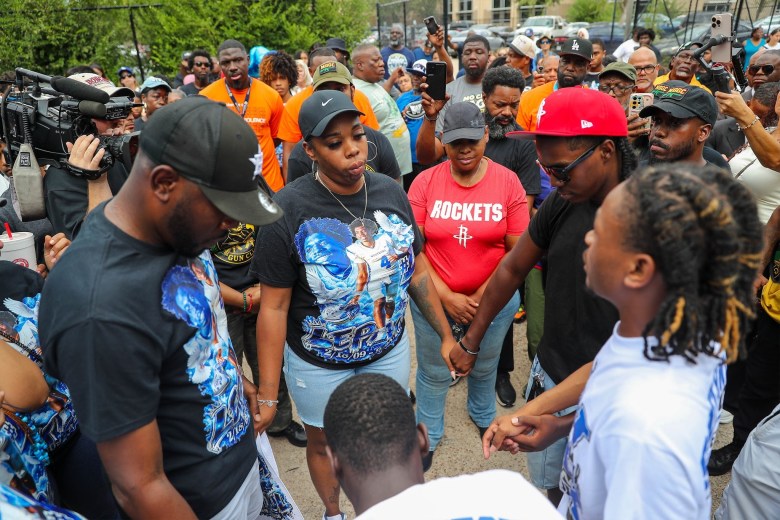
Nearly 300 people gathered in the Westbury community recently to remember Warren, including relatives, classmates, alumni, elected officials, and residents who never knew him.
The gathering was part memorial, part demand for something to change.
Rodney Jones was among those who did not know Warren personally. He came because he is from the area and has children around Warren’s age.
“When I heard about this tragedy, I didn’t know this young man. I didn’t know his family, but it hit so close to home,” Jones said.
For some families, one shooting can make every subsequent shooting feel personal.
A community activist known as Texas Tea attended after losing his own son to gun violence. He described the lasting impact of that loss simply: “Every day is Nov. 5,” referring to the date his son died.
He said adults must make young people understand that their lives have value.
“We just need to let our babies know that they’re valuable and we love y’all,” he said. “Everything y’all going through, we see that. We do not discount it.”
That message mirrors what Prater believes could make a difference.
She wants more adults, particularly men, willing to mentor young people who may not have strong support systems at home or who may be reluctant to tell their parents what they are experiencing.
“Some people don’t have what my son had at home,” Prater said.
Warren’s family is also looking beyond its own grief. In its statement, the family said it hopes to work with organizations committed to ending gun violence in Houston.
What happens after the headlines fade?
While much of the attention has focused on what happened outside Westbury High School, Warren’s family is also concerned about what happens next inside the school.
Westbury’s homecoming football game and dance were canceled following Warren’s killing. His family has urged HISD and school administrators to reschedule the activities, saying students throughout the school are grieving and need an opportunity to regain some normalcy.
“This tragedy has affected not only our family, but the entire community,” the family said.
More than another statistic
Warren was a football and basketball player, but his mother wants people to know the teenager behind the uniform and beyond the circumstances of his death.
At home, he ran through the house, joked around when it was time to clean, and made TikTok videos with his sister.
“He was just one of them kids, like it’s rare that you’ll find him sad or down,” Prater said. “He loved his family.”
He was playful, she said, always saying something that made the people around him laugh.
“Everybody wants to be around La,” Prater said. “He was just a good kid.”
Witchet’s family has been left asking many of the same questions.
At a memorial for the 15-year-old, his grandfather said the question after these shootings is often why they happened. He believes Houston should be asking something else.
“The question that needs to be asked is, when are we going to do something about it,” he said.