Kaima Marie Akarue sits quietly, basking in her work at the University of Houston’s Elgin Street Studios.
Here, amidst the scattered tools and materials of her creative process, Akarue, a multi-faceted Black artist, educator, and mother, is crafting not only artwork but her very own narrative.
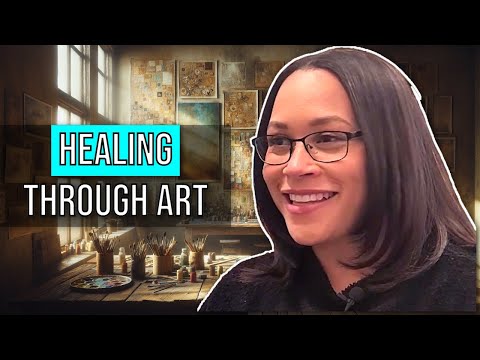
Akarue is building worlds that reflect the complexities of her experiences as a bicultural artist while pushing boundaries within the Houston art scene through the medium of collage.
Her journey to becoming an artist was not linear. “I’ve always been crafty,” she says with a laugh, recalling how she spent summers with her grandmother painting decoupage eggs—a craft she initially resented for keeping her from her friends.

Only years later, as she ventured into college, Akarue discovered art’s true role in her life. After initially pursuing journalism and dreaming of moving to New York, a chance art class would forever alter her path.
“I thought I was going to move to New York, but after visiting, I realized it wasn’t for me,” she recalls. A shift occurred, leading her to change her major and eventually find her way back to the medium that would define her career: large-scale collages.
In Akarue’s hands, collage is more than just a way of creating—it’s an act of historical preservation, a tactile engagement with the world. “I’m painting with paper,” she says, describing her signature technique.
It allows her to construct intricate, immersive spaces, often on a grand scale. Her large collages deviate from the traditional, where works are often small and confined to the size of a smartphone screen.

Jakayla Monay, a Houston artist and friend of Akarue, recalled a piece called “And The Beat Goes On,” depicting Akarue’s admiration of her father and his love of music.
“That connected with me because I have a close relationship with my dad, who also loves music, she said. “I’ve centered my father in my own work, so connecting with her on that level made her art feel personal and meaningful.”
Monay also spoke about the importance of community and collaboration among Black artists.
“The art space can feel lonely, and it’s majority white. Finding those who share experiences with you is important to make you feel like you’re not alone. Someone you can seek for advice. That is what Kaima’s friendship means to me,” she said.
Her vibrant and layered pieces bring to life the stories of identity, memory, and culture that define her personal and artistic journey.
“I’m Nigerian, but I’m also biracial,” Akarue says, noting that navigating her identity as a child was often a challenge. These struggles are reflected in her artwork, where themes of identity, memory, and cultural negotiation take center stage.
Her experience as a mother—particularly raising children with varying skin tones—has highlighted the complexity of identity within her own family. Her daughter would often lie to her friends, saying her mother was Mexican instead of acknowledging her biracial background.
Meanwhile, her son faces the challenges of colorism, his fairer skin sometimes complicating his relationship with his Black identity.

This tension between personal identity and the way the world assigns labels is central to Akarue’s artistic exploration. In her work, she creates spaces for dialogue that do not provide easy answers but encourage reflection. “I can’t change the world,” she says, “but if I can incite change on a micro level, just by getting people to question something, then that’s the purpose behind my work.”
Her background as an artist and educator is foundational to her mission. Akarue’s journey into teaching—now spanning 15 years—has allowed her to share her knowledge with others while also learning from her students. Teaching art, journalism, and graphic design at the school where she graduated, she has come to view education as essential to her practice.
Yet, as an artist, she has faced significant challenges, particularly as a Black woman working in Houston’s art world. “The challenge is sustainability,” she admits. While she has found doors to walk through, the journey has been fraught with bureaucracy and questions about the ethical implications of participating in certain institutions.
However, Akarue has found a sense of community and belonging through her academic journey. Entering graduate school in her late 30s marked a pivotal moment for her. “Going back to school was the best decision I made,” she says. “It gave me a community and allowed me to define the artist I want to be. It made me sharpen my intention.”