The 81-years-young Dr. James Douglas has literally seen it all.
Long before enjoying his current role as Distinguished Professor of Law at Texas Southern University’s Thurgood Marshall School of Law, he was the dean. Douglas also served as president of TSU, his alma mater, where he was a student body president.
Douglas also enjoyed educational and professional experiences at Stanford University and Florida A&M University, respectively. Along with being a practicing attorney and law school professor, the longtime math and science whiz has also given a lifetime of service to the community in various roles, the most prominent of which was his tenure as president of the NAACP Houston Branch.
Douglas agreed to be part of the Defender series “Houston-area elders share wisdom gems to empower.”
Choosing a profession
Douglas shared that as a teenager, he came upon an awareness that altered the course of his life. He realized that if a person sleeps on average eight hours a day, that leaves 16 waking hours.

“I watch my parents come and go to work , and I said, ‘You know, between the time they leave home and the time they get back, it’s about 10 hours. That means almost two-thirds of that day is spent doing something related to work,” said Douglas. “So, the most important thing you can do in life, the most important decision you have to make, is your profession.”
Douglas took “the road less traveled” to identify his career path.
“The big portion of that decision is figuring out how you want to spend your day,” said Douglas. “The mistake most people make is they pick a profession and then they try to fit themselves in that profession rather than sitting down, spending some time trying to figure out, ‘Do I want to spend my day inside, outside, using my hands, using my brain; am I an introvert or extrovert? Do I want to spend my time with people? Do I want to spend my time alone?’ Once you figure that out, then I tell people to find a profession that allows you to do what you want to do every day.”
Taking that approach led Douglas to choose a career path everyone advised him not to take. But it certainly worked out for the best.
“I was not concerned about what anybody else wanted me to do. And at 81 years old, that’s why I still come to work every day. That’s why I still enjoy what I do because I am doing what I said I wanted to do every day of my life,” he added.
Staying true to yourself
Staying true to one’s self is certainly a recurring theme throughout Douglas’s life. Doing so led him to make unorthodox decisions that ended up being the right moves.

Take, for example, his decision as a 9th grader during his school’s career day. Douglas went to the room occupied by Henry Doyle, a Black lawyer who was the first graduate of TSU’s Thurgood Marshall School of Law. However, because Douglass was such an excellent math and science student, coupled with the nation’s magnified emphasis on those subjects during the global Space Race, his counselor attempted to dissuade Douglas from going into law.
“My counselor said, ‘You don’t want to be a lawyer. A Black lawyer cannot make a living in Houston. You’re too good a math and science student,” recalled Douglas.
Ironically, though on a pre-law track in college, Douglas changed majors from the traditional pre-law major of political science, to, of all things, math.
The department head of the political science program thought Douglass was crazy for abandoning political science if he was serious about going to law school. Amazingly, however, Douglas’s decision proved to be the right one.
“Fast forward to the late 80s, early 90s, I was on the board of law school admissions services, the people that give the law school admissions test. One day, in a board meeting, a guy said, ‘We tell students all the time, you can major in anything and go to law school. And while that’s true, we’ve never tried to find out whether one major prepares you better for law school than another,’” recalled Douglas. “So, we decided to commission a study to find out which major prepared students best for law school. And surprising to everybody, math prepared students better for law school than any other major. So, unbeknownst to me, I made a wise decision to change my [undergraduate] major to mathematics.”
Juggling persona and private life
As a public servant with multiple demanding professions, Douglas has had to balance those with his personal life. Though he doesn’t have a magic, drama-proof answer for making it work, he does have advice for a similarly busy person: ” Be honest with your partner and be honest with your family.”
“You have to have the right support system,” he continued. “You have to have a family who understands that you are going to be going a lot.”
Douglass, who has a daughter and son, knows personally that the juggle-struggle is real.
“My daughter always tells me, ‘You are probably a good father for Deuce [his son]. But I needed more attention,’” Douglas recalls. “So, it is a delicate issue because it does take away a lot of time from your family. I always tell people you have to make sure that the time you spend with your family is really quality time.”.
On becoming a leader
Douglas has not only been an effective leader for decades but has also mentored his fair share. He offers very pointed advice to young people seeking to step up as modern-day change agents, especially those who voice words of discouragement because older leaders won’t get out of the way and give them a chance.
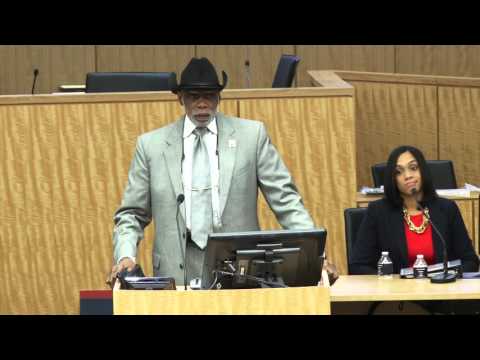
“First, leaders don’t ask to lead. I’ve never known a leader say, ‘Let me be a leader.’ Leaders are asked to lead…,” Douglas said. “My generation, we knew if we wanted to be leaders, there were certain things we had to do and we had to prove to older adults that we could lead.”
He added: “If you are prepared to lead, other people will recognize it. You don’t have to ask people to be a leader. They will ask you to be a leader. But you have to be prepared.”
One of the things Douglas did when he was dean of the TMSL and president of TSU was over-emphasizing the importance of preparation to students aspiring to leadership roles.
“To the young leaders, sometimes I would say, ‘You know, when I was your age, I’d be embarrassed to go into the president’s office or go into the dean’s office as unprepared as you are’ because if you’re going to be a leader, you’ve got to do all the preparation that’s necessary to be a leader.”