Prairie View A&M University stood for 150 years, trained generations of Black professionals, and sent graduates across every sector of American life.
Yet outside the HBCU community, its story is rarely told on the same terms as those of other Texas institutions. Dancer and activist Harrison Guy wants to change that, one movement at a time.
Dear Prairie View, a multidisciplinary production commissioned by Performing Arts Houston, will have its premiere Sept. 4–5, 2026, at the Wortham Theater Center. Created and choreographed by Guy, the evening-length work spans the university’s full arc, from its founding on a former plantation during Reconstruction, through the Civil Rights era, to student life today, using dance, original music, spoken word, and visual storytelling.
Guy is the Houston-based founder of Urban Souls Dance Company and a former PVAMU student whose connection to the university runs deep. He spent roughly three years researching and collecting material before formally beginning production earlier this year. The piece grew significantly in scope after it was selected for Performing Arts Houston’s New Now programming, expanding from an originally planned 25-minute work into a full evening.
“I often think that people think there are no Black people in Texas,” Guy said. “I see this as an opportunity to really remind people, teach people, inform people that there are Black people in Texas, and they’ve done amazing things.”
The institution’s origins are tied to the 1876 amendment of the Texas Constitution, which simultaneously enabled the founding of what is now Texas A&M University and created the legislative opening for a separate school for Black Texans. Prairie View was established on the grounds of the Alta Vista Plantation in Waller County. Its first eight students, known as the Alta Vista Eight, began classes in 1876, laying the foundation for graduates in law, medicine, engineering, education, and the arts.
Guy said he researched the production through both the university’s institutional archive, which he described as unusually rich for a Black history project, and through oral history, speaking with former students, people who grew up near campus, and those who worked or taught at the university. One piece of archival footage struck the entire creative team. A television recording of the Prairie View Concert Chorale performing for Dr. Martin Luther King Jr., approximately two weeks before his assassination in April 1968.
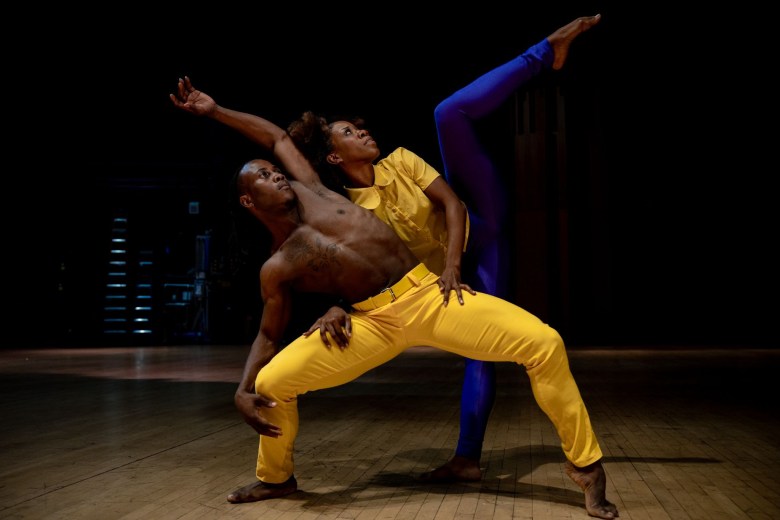
Rather than staging a strict historical reenactment, Guy said the dance medium offers him creative and emotional latitude that written or documentary accounts cannot. In sections on activism, including a segment honoring Sandra Bland, he chose to memorialize rather than recreate, allowing movement to carry grief and dignity simultaneously.
“I want people to really understand the HBCU celebration of it, celebrating what the difference of going to an HBCU is,” Guy said. “The production features Prairie View-affiliated talent throughout. A PVAMU alumnus designed the lighting, a current faculty member and an alumnus composed the original score, and Mr. and Ms. Prairie View will appear on stage.”
The original score was composed collaboratively by Dr. John L. Cornelius II and Brandon Willis. Cornelius, a professor of music, piano studio, and composition at PVAMU for 22 years, earned his Doctor of Musical Arts degree in composition from Rice University. Willis is a PVAMU alumnus who graduated in 2016 with a bachelor’s degree in vocal performance, and the two have known each other since Willis arrived on campus in 2012.

The cast of Dear Prairie View includes PVAMU’s Classic Dance Ensemble alongside Prairie View-affiliated designers, composers, and poets. Credit: Sara Buchsbaum 
The cast of Dear Prairie View includes PVAMU’s Classic Dance Ensemble alongside Prairie View-affiliated designers, composers, and poets. Credit: Sara Buchsbaum 
The cast of Dear Prairie View includes PVAMU’s Classic Dance Ensemble alongside Prairie View-affiliated designers, composers, and poets. Credit: Sara Buchsbaum 
The cast of Dear Prairie View includes PVAMU’s Classic Dance Ensemble alongside Prairie View-affiliated designers, composers, and poets. Credit: Sara Buchsbaum 
The cast of Dear Prairie View includes PVAMU’s Classic Dance Ensemble alongside Prairie View-affiliated designers, composers, and poets. Credit: Sara Buchsbaum
Cornelius and Guy developed a structured framework, which he called “filling in the frame”, identifying which historical moments carry the most emotional weight and how to sequence them without losing the narrative’s momentum. For the sonic arc, the team is using a virtual orchestra to track the university’s evolution through sound, starting from acoustic instruments meant to evoke the earliest era and gradually introducing electric organ, guitar, electric piano, and synthesizers as the timeline moves toward the present.
Willis, who also has experience composing for Houston’s Black-owned dance company Nia’s Daughters, said the archival footage of the Chorale performing for Dr. King was transformative for him. He attended Prairie View and sang with the Chorale himself, yet had never known of that moment before Guy showed him the recording. That discovery deepened the responsibility he felt in setting those years to music.
“I want people to really understand the HBCU celebration of it, celebrating what the difference of going to an HBCU is.”
Harrison Guy, choreographer, Dear Prairie View
“It’s just an honor to be able to be part of it. Connecting things all the way back from slave song through to Moses Hogan-esque hymns and classical neoclassicism,” Willis said. “With strong ties to the rich choral and band history that has poured into even today’s modern music. It all connects in its own way.”
Guy’s choreographic approach made the collaborative challenge less daunting than it might otherwise be. Because Guy’s movement is already highly narrative and emotionally specific, the music does not need to carry the explanatory load alone. Projected imagery, audio clips, and dance each occupy defined roles within the production’s structure, allowing the score to prioritize feeling over exposition.
“It’s for everybody,” Cornelius said. “But the big difference is that for people who have a connection to Prairie View, it’s going to hit them a little closer to the bone.”
Tickets for Dear Prairie View are available through Performing Arts Houston at performingartshouston.org.