For Sharman McGilbert, learning heating and air conditioning was a transformational change in her professional career, charting her next steps as a mid-career woman in STEM.
McGilbert spent roughly two decades working in polymer science, rising from laboratory technician to principal polymer scientist after earning a bachelor’s degree in biology and chemistry from Texas Southern University. Her work included materials used in products ranging from automobiles to athletic shoes.
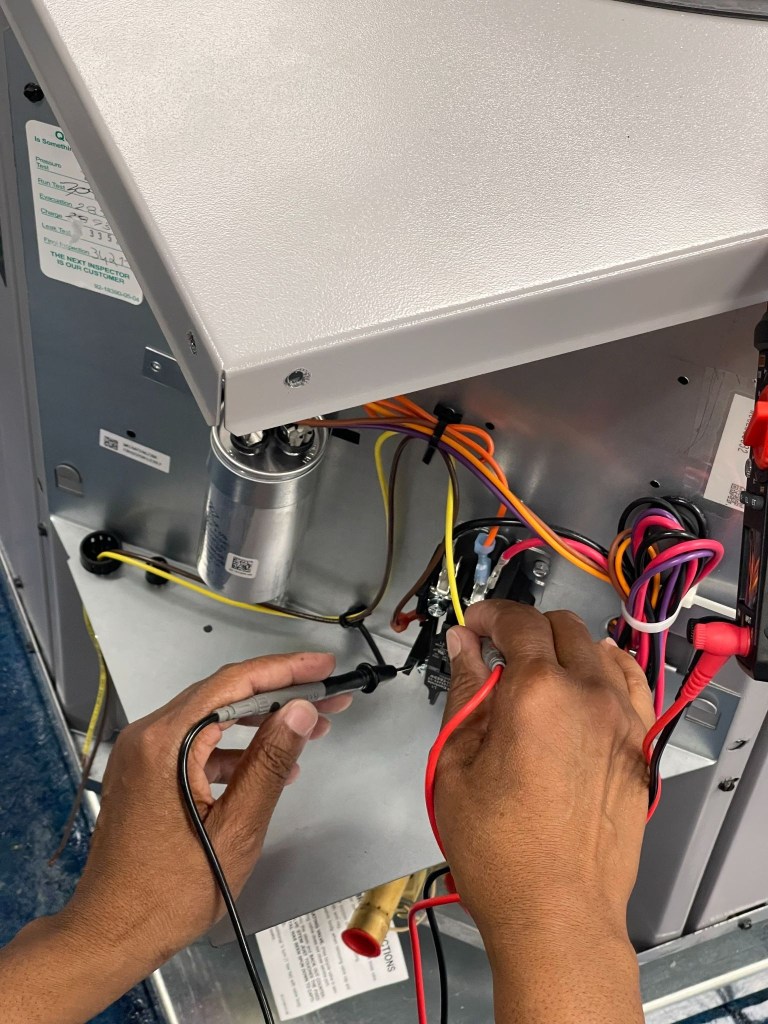
Now, she is back in college, studying heating, ventilation, air conditioning, and refrigeration at Houston City College. Her move to HVAC was a deliberate mid-career transition, fueled by a long-standing interest in mechanical equipment. 15 years ago, McGilbert’s air-conditioning system broke down, and she began to wonder about the field.
Later, she helped develop a prototype air conditioner for the Global Cooling Prize, an international competition focused on reducing the energy use and carbon footprint of residential cooling. It led her to think, “This is pretty important stuff,” and her interest continued to grow.
“There are no jobs really that women or men do. There are just jobs,” McGilbert said. “Then there are qualified individuals who perform the task for those jobs. I would definitely encourage young women, particularly young women of color, who are interested in pursuing a career in the trades. If you’re on the fence about it, come over here and take a couple of classes and see if it’s for you.”
An opportunity for Black contractors looking for a trade


The HVAC program also provides an opportunity for Black contractors looking to expand the community’s footprint in a field where they are underrepresented.
Nationally, Black workers account for 6.3% of all employed Americans as of July 2026, but only 5.4% of workers across natural resources, construction, and maintenance occupations, according to the U.S. Bureau of Labor Statistics.
BLS projects that nationwide HVAC employment will grow 8% from 2024 to 2034, creating about 40,100 openings annually, including positions vacated by retiring workers.
The occupation’s national median wage was $59,810 in 2024.
Meanwhile, construction remains one of Houston’s largest employment sectors. Workforce Solutions Gulf Coast forecasts that construction will add about 5,600 jobs in 2026, while some sectors more closely tied to upstream oil activity are expected to weaken.
For institutions such as Houston City College, training more Black technicians could help employers fill vacancies.
It could also provide a pathway into a growing technical occupation with opportunities for business ownership.
Pleasant said HCC sees itself as part of that effort.
“We are building confidence,” she said. “We are here to provide support to the African-American community, because historically they have been underrepresented, particularly in HVAC.”
Mid-career changes are becoming more common
McGilbert’s move illustrates a career path that instructors at HCC say they increasingly encounter. Adults arrive in the trades with years of work experience behind them, sometimes after layoffs, seeking advancement and, at times, simply reconsidering what they want from the next phase of their working lives.

At HCC, HVAC instructor Adrian Gill also sees experienced tradespeople aging out of the workforce.
“We’re losing a lot of people,” said Gill, pointing to older technicians retiring or selling businesses, while too few younger workers are ready to replace them. “A lot of the younger generation are not in place and not properly trained.”
The gap creates an opening for career changers.
Gill advised others considering a similar switch to first understand the industry from the inside.
“Begin to expose yourself to behind the scenes of HVAC and refrigeration so you can see the opportunities there,” he said.
A college classroom built for different starting points
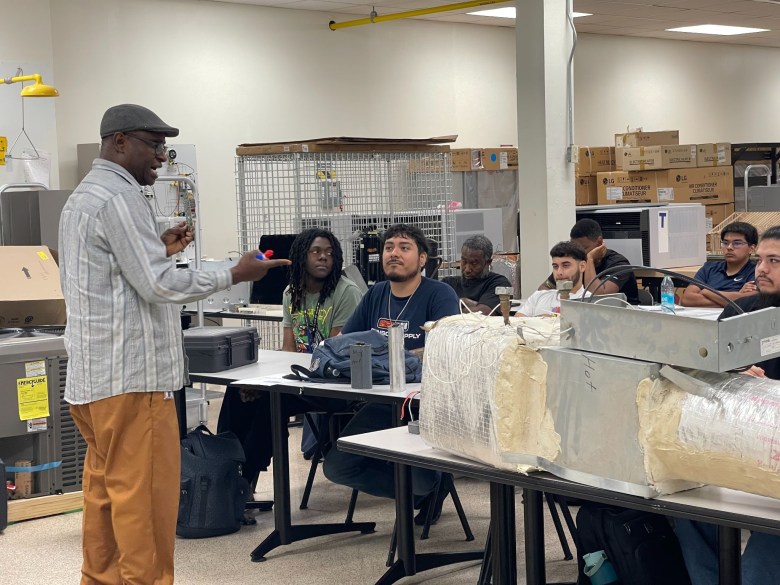
HCC offers several entry points. Its workforce HVAC program includes a 21-credit basic certificate, a 42-credit advanced certificate, and a 60-credit Associate of Applied Science degree.
The AAS is a two-year, full-time program offered in person at several campuses.
For someone wanting an even shorter route, HCC also offers a 160-contact-hour Air Conditioning Technician Occupational Skills Award through continuing education.
Tuition is listed at $1,128, excluding books and certification-exam vouchers.
The program covers HVAC principles, thermodynamics, maintenance, refrigerant handling, safety, and the mechanical and electrical systems found in contemporary equipment.
McGilbert completed her first workforce certificate part-time in less than a year and decided to continue toward an associate degree.
Because she already holds a bachelor’s degree, she said some general education requirements were already satisfied.
The college also divides fall and spring courses into eight-week sessions. The accelerated format, McGilbert said, helped her move through the program efficiently while gaining hands-on experience.
What is the goal?
Cheryl Pleasant, HCC’s interim chair overseeing construction, electrical technology, and HVAC-related programs, said the goal is to make the curriculum approachable even for people who have never held a wrench.
“We’re gonna start off with what a basic hand tool is, and we’re gonna build from that,” Pleasant said. “We’re gonna meet you where you are.”
HCC’s approach mirrors a challenge facing community colleges.
Adult students often juggle employment and other responsibilities.
Nationally, colleges trying to attract and retain them are increasingly emphasizing accelerated programs, flexible scheduling, coaching, and other targeted support, according to New America.
Not the old trade job
The image of HVAC as purely manual work also misses how technical the occupation has become.
HCC says its curriculum combines traditional skills with emerging technologies designed to improve building performance and energy efficiency.
Students also learn safety and other workplace skills.
Instructor Matthew Dydek teaches students to use multimeters and understand electrical circuits while working with advanced commercial air-conditioning equipment.
“There are no jobs really that women or men do. There are just jobs.”
Sharman McGilbert, student at HCC
For Dydek, the hands-on approach was part of the appeal when his own career was disrupted.
“I was originally in oil and gas, and I got laid off,” he said. “So I had to reflect on what I needed to do.”
Dydek noticed HVAC employers were hiring. He went back to school and discovered that the subject suited him.
“These classes that we teach are like little science classes, but applied to something specific,” Dydek said.
His career eventually brought him back to the classroom as an instructor.
Dydek also cautions against expecting an instant windfall.
He said he initially earned about $15 an hour in HVAC before his income increased with experience.
Last year, he said, he earned more than six figures.
“They don’t make that kind of money straight away,” Dydek warned. “There’s still a learning curve.”
HCC’s own career outlook puts the average Houston-area salary in the field at $56,005, with 8,811 people employed and a projected local growth rate of 7.5% from 2026 through 2030. Nationally, BLS projects employment of HVAC mechanics and installers to grow 8.1% over the decade covered by its latest projections, faster than the average for all occupations.
Gill tells students that education does not end with a certificate.
“I teach my students to be a student forever,” he said. “Basically, always keep learning.”
A deliberate second act
McGilbert describes herself as entering the “third quarter” of her career, late enough to have accumulated substantial professional experience but with plenty of time left to build something different.
“The third quarter is really important because it’s a good chance to catch up,” she said. “It’s a good chance to fix some things that maybe you didn’t do so well in the first half of the game.”
She hopes eventually to work in commercial refrigeration or a manufacturing environment before moving into teaching or mentoring.
For Houston workers navigating layoffs or simply a change in priorities, the need to work in the city, where air conditioning is an infrastructural necessity during summers, is unlikely to disappear.
Dydek said the stigma surrounding trades is fading.
“People are starting to see that this is a real career option,” Dydek added.