Every year, the City of Houston alone spends roughly $190 million on goods and services.
Much like the residents of the city, the government, too, needs toilet paper and weed eaters. Add to that legal services and IT help.
What does that have to do with Black businesses? Opportunity, Houston-area experts say.
“We don’t come with anything. Everything that we need, we purchase,” said Cylenthia Hoyrd, director of the Office of Business Opportunity at the City of Houston.
The city, Harris County, Harris Health, Houston ISD, and any other government entity are moving public dollars through state and federal agencies. And on the other end of the transaction is a business owner supplying those services.
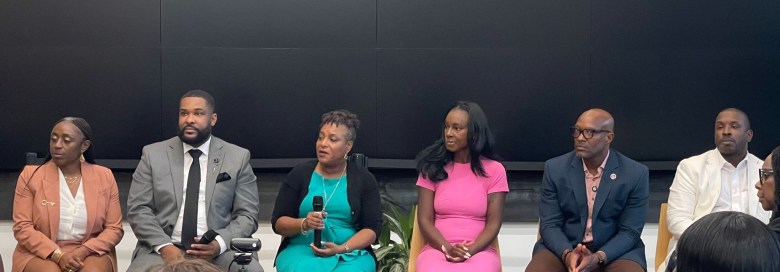
Those leading institutions helping Black business owners say government contracting is not out of reach. They are not reserved for large companies with a multitude of contacts in government, said a panel of experts who gathered at Harris County Commissioner Rodney Ellis’ office to discuss government contracting.
Per Hoyrd, the city structures its procurement and contracting across four categories: Construction; professional services such as engineering and accounting; goods, such as the delivery of materials and commodities; and non-professional services, such as janitorial upkeep and landscaping. Black-owned businesses can join a co-op to make it easier to do business with the city, she added.
In the 2025 financial year, the city awarded more than $2.5 billion in contracts across these four categories, out of which around $580 million went to certified Minority, Women, and Small Business Enterprise (MWSBE) firms.
A program in legal limbo
Government and corporate contracts are among the more direct paths to scale, but the pipeline for that work is currently in flux. The race component of Houston’s Minority, Women, and Small Business Enterprise (MWSBE), which awarded a percentage of the city’s contracts to underrepresented businesses, was deemed unconstitutional by U.S. Judge David Hittner.
Contractors Jerry and Theresa Thompson, a white couple, had filed a lawsuit against the city and the Midtown Management District, accusing the city of hiring businesses based on race, and sought to end the M/WBE program. Hittner ruled in their favor.
A 2023 disparity study highlighted which businesses were being underutilized.
The study found that among all MWBE businesses, Black-owned businesses were severely underutilized. Despite comprising a 7.7% availability rate, only 5.55% were utilized.
Separately, the HUB certification program was restructured and is now limited to veteran-owned businesses.
These programs provided a pipeline for Black business owners to provide their services to the city.

Dr. Asheli Atkins, president and CEO of the Greater Houston Black Chamber, said her biggest fear is not the legal fight itself but businesses pausing their certification applications, assuming there is no point, only to be caught flat-footed if and when the program returns.
“We still want you to move forward with getting your certification,” Atkins said. “Eventually, these programs will be brought back to the table.”
While the fate of the city’s MBE program hangs in the balance, its certifications remain intact, and the city is appealing Hittner’s ruling.
Hoyrd reminded business owners that the city can no longer use race as a factor in awarding or monitoring contracts. But firms holding certifications can still have their participation considered under the surviving categories.
The certifications will not be deleted, just delisted from the active directory used for city awards.
“They did not sue about the women. They only sued about jobs,” Hoyrd said. “So the MBE portion is the portion that is gone. The MBE certification can be used for every other entity. That is still constitutional. If you want to use it for the county, go right ahead.”
An HBCU pipeline to bidding
Getting ready to become a vendor and competing for bids as a business grows are two separate things.
This is why Johnny Gentry, Harris County Extension Agent for PVAMU Extension, runs a nine-week “B.I.D. Academy” course through the university’s extension program.
“In the church, we have a saying that a call to preach is a call to preparation,” Gentry said. “But I want to say that a call to procurement is a call to preparation.”
Learn the fundamentals
Atkins noted that while entrepreneurs are adept in their fields, it does not automatically make them business experts.
Learning the fundamentals of making a business is as important as pitching the idea to the city to land contracts.
Atkins also warned that balancing a full-time job with entrepreneurship comes with its own challenges. The combination of a lack of business acumen and insufficient time to invest in an idea can undermine its long-term scaling potential. Instead, she suggests owners hire Black service providers to help with areas they are not comfortable with, such as website designs and accounting.
“What they’re essentially doing is they are just using their personal credit card or their personal debit card as also like a business card,” Atkins said. “They are using their income from their 9-to-5 to fund their entrepreneurship goal. They don’t know how to separate the two.”
Often, she has noticed a feeling of shame among owners when they do not “have it together”. There is no reason to feel that way, per Atkins.
“We romanticize what’s on the social media aspect of actually becoming a solopreneur and hobbyist, but never really understand what it takes to learn the business.”
Brandon Davis, MBE Services director at the Houston Minority Supplier Development Council
“You don’t have to know everything,” she added. “You can literally find a Black business that offers the service that you need within your budget to get you where you need to go.”
No credit to the ‘self-made’ trope
Brandon Davis, MBE Services director at the Houston Minority Supplier Development Council, tracks capacity issues among member companies.
Citing economic reports, Davis said he often finds Black businesses “at the bottom”, attributing it to how Black businesses are structured.
“A lot of companies don’t have the capacity, don’t have the bandwidth,” Davis added.
“The fastest way to expand that capacity is a partnership, not just with someone with a complementary business but someone in the exact same space that you’re in,” Davis advised.
Start with the right-sized opportunity
Rather than chasing multimillion-dollar prime contracts out of the gate, panelists urged entrepreneurs to build a track record on smaller, less competitive ground first.

Bryan Smart, founder of Smartscaping, who now works with the city and HISD, said he built his business by first competing for contracts with management districts and municipal utility districts, smaller entities with simpler procurement processes and more accessible decision-makers.
“Go and be competitive in a smaller pond first and grow to be a shark, and then go to the ocean to be competitive,” Smart said.
Smart also credited part of his early success to researching, in his own time, which companies already held city contracts and modeling his business, down to the trucks and equipment, on what agencies were already buying.
Understanding what a government buyer needs before a solicitation is posted, panelists said, is what separates a competitive bid from a hopeful one.
LaTisha Grant, a Realtor in Acres Homes, took a similar path through grants rather than contracts, writing a proposal to MD Anderson to fund a fitness and food-access program in Acres Homes.
She’s won that roughly $50,000 award three years running, each renewal built on the credibility of the last.
“If there is an issue, there is someone out there that has the funding to solve it, especially when you’re located in a low to moderate-income community,” said Grant, but cautioned that nonprofit status doesn’t lower the bar on financial discipline. “Prepare a budget and actually use the funds for what it is that you said that you’re going to use them for.”