Behind the visible statistics of Houston’s homeless population lies an “invisible” crisis affecting 141,000 residents who are currently couch surfing, living in cars, or short-term motels and shelters. New data from Rice University’s Kinder Institute sheds light on the sheer scale of the problem and reveals a racial disparity in the numbers.

The results are based on a survey of nearly 8,800 residents in Fort Bend, Harris, and Montgomery counties. About one in 20 residents fell into this “invisible” category over the past year, a rate that more than doubles for households earning under $50,000.
Dan Potter, director of the Houston Population Research Center, who led the survey, said those experiencing temporary homelessness are impacted to a similar extent as those going through visible homelessness.
“We see homelessness when it’s on our streets, under our highways and in our shelters,” Potter said. “Temporary homelessness, on the other hand, is invisible. However, housing instability, whether we see it or not, matters for people’s health, for children’s education, and for economic mobility.”
Black residents in Houston
For Black Houstonians, a separate crisis is unfolding. More than 7,000 Black residents lost their homes, according to a companion report from the Kinder Institute. The reversal is happening as insurance premiums climb faster than home values.
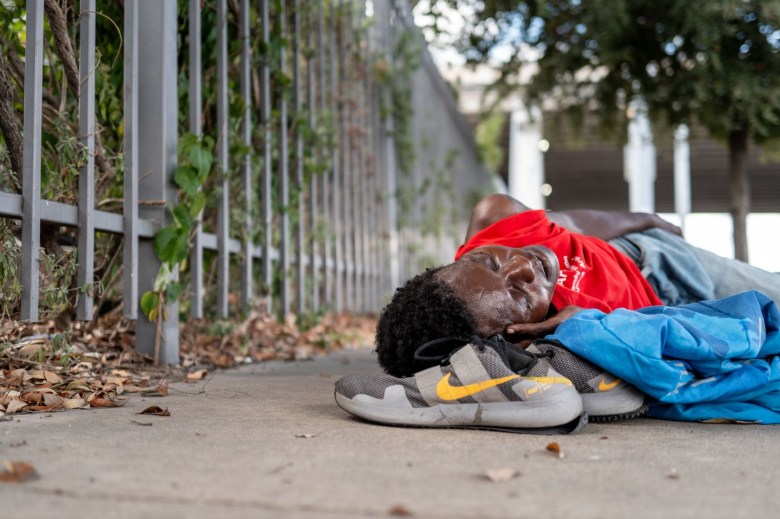
Additionally, Black individuals are disproportionately represented among those experiencing homelessness, accounting for more than half of the total population, according to newly released data from the Coalition for the Homeless of Houston/Harris County (CFTH). The report identified over 3,300 people experiencing homelessness in its annual “snapshot” count.

City Council Member Tiffany Thomas, who chairs the city’s Housing and Affordability Committee and has held mobile care days for unhoused residents in her district, said the data reflects what she has seen firsthand. But, in order to address homelessness, in which Black Houstonians are overrepresented, empowering the community is key, per Thomas.
“If you want to solve homelessness, you have to address Black empowerment and support the Black community,” Thomas said. “It’s a part of systemic racism for decades, when you look at any spectrum of what’s happening from birth to adulthood, we are over-indexed on the wrong side of the statistic. There hasn’t been a targeted effort, particularly for Black folks in Houston, for us to interrupt that.”
By the numbers
Residents are finding it increasingly difficult to pay for rent, especially those making less than $25,000 a year. Moreover, rising daily expenses and bills lead to financial strain and the inability to pay rent.
Reflecting on this instability, Thomas described how a temporary crisis can spiral, noting that the city’s funding may not be enough to tackle “invisible homelessness”.
“We’re not funded at scale in the city of Houston,” she said. “No U.S. city is funded at scale from the federal government to really address homelessness the way that we need to, based on the demand. Because homelessness is presented in different ways. It’s not exclusively mental health or drug addiction. It’s also the criminal justice system, domestic violence, separation of family, divorce, and natural disaster.”
If not direct aid, Thomas added that the solution is in building pathways back to stable, well-paying work, connecting people to case managers, IDs, job training, and healthcare.
“If you want to solve homelessness, you have to address Black empowerment and support the Black community.”
Tiffany Thomas, Houston City Council Member
While these targeted interventions are essential for immediate stabilization, Kelly Young, president and CEO of the Coalition for the Homeless of Houston/Harris County, said closing the gap will require sustained investment across the full housing continuum, including prevention and stable housing.
Young referred to The Way Home, Houston’s homeless response system, which provides the next layer of support to help people regain housing stability, “so fewer people fall through the cracks, and everyone can access the right support at the right time before a temporary crisis becomes long-term homelessness.”
“These findings remind us that homelessness rarely begins on someone’s first night in a shelter or on the street. It often starts much earlier, with a housing crisis that families are doing everything they can to overcome,” Young said.