The November 2024 presidential election was one for the ages. Donald Trump returned to the White House after attempting to overturn the 2020 election results, culminating in the Jan. 6, 2021, attack on the U.S. Capitol.
His victory also exposed divisions among voters, many of whom were expected to oppose his return.
Despite mobilization around reproductive rights, racial justice, and democratic protections, 53% of white women voted for Trump, according to widely reported national exit-poll estimates. Shifts among some Latino and other traditionally Democratic-leaning voters also complicated expectations about a durable Black-Brown political coalition.
But perhaps no voting pattern generated more scrutiny than that of Black men.
Black women again demonstrated overwhelming support for Democratic presidential nominee Kamala Harris. Black men, meanwhile, remained overwhelmingly Democratic, although a larger percentage supported Trump than in 2020 or 2016.
That distinction matters. The increase prompted legitimate questions about political priorities, party outreach, misinformation, sexism, and economic frustrations. But it also produced a broader narrative suggesting Black men had abandoned the Democratic Party.
The numbers tell a more complicated story.

The numbers
Black men did shift toward Trump in 2024, but they did not become a Republican voting bloc.
Pew Research Center’s validated-voter analysis found approximately 77% of Black men voted for Harris, while 21% voted for Trump. Among Black women, approximately 92% supported Harris, and 7% supported Trump. The findings demonstrate both a gender gap among Black voters and the continued Democratic preference among Black men.
Exact percentages vary among surveys because exit polls and validated-voter studies use different methodologies. Nevertheless, the broader pattern is consistent: Trump increased his support among Black men without winning a majority of their votes.
Carroll Robinson, a former Houston City Council member, emphasized that distinction in comments to the Defender.
“Nonetheless, Black men are a greater base of support for Democrats than any other group of voters except Black women,” Robinson said. “That was even in 2020 and 2024.”
His assessment challenges the suggestion that one election fundamentally transformed Black men’s partisan allegiance.

Why the shift?
Several factors help explain why some Black men moved toward Trump. No single explanation accounts for their decisions, and Black men should not be treated as a political monolith.
Economic frustration was significant. Some voters believed Trump would improve affordability, create jobs, and expand economic opportunity. Others expressed dissatisfaction with the Democratic Party’s record, messaging, and attention to Black men’s specific concerns.
Misinformation also played a role. False or misleading claims about Harris’ record, racial identity, and commitment to Black communities circulated online. Out-of-context video clips further complicated voters’ assessments of her positions.
According to Michael Bland, executive director of Black Men Vote, Black men between the ages of 18 and 45 are the biggest consumers of misinformation.
“Black men are a greater base of support for Democrats than any other group of voters except Black women.”
Carroll Robinson
Sexism and patriarchy warrant examination, too. Some Black pastors and commentators discouraged support for Harris because she was a woman.
There’s also a longer-term concern: Democrats cannot assume historical loyalty guarantees future support.
“Democrats need to do much more to reach out to Black men about our issues and concerns, no matter who the Democratic candidate happens to be,” Robinson told the Defender, adding that Democrats must improve outreach to men across racial and ethnic groups.
And according to Roland Martin, founder of the Black Star Network, the first sign of Black male erosion from supporting Democrats wholesale was in 2012.
“I said, ‘Y’all, Black men said they were not satisfied with what [President] Obama did in the first four years,’” said Martin on a recent episode of #RolandMartinUnfiltered. “But because the [percentage of Black males voting for the Democratic Party] was still in the high 80s, folk were like, ‘Oh, it’s no big deal.’”


The overreaction
Still, the claim that Black men have become a Republican voting bloc is inaccurate.
In 2024, Pew’s validated-voter analysis found 21% of Black men voted for Trump. That means approximately four out of five voted for Harris. Trump increased his share of Black voters overall from 8% in 2020 to 15% in 2024, but 83% of Black voters still supported Harris.
Those numbers reveal a shift, not a wholesale partisan realignment. That distinction matters in Texas, where closely contested statewide and congressional races can be affected by turnout, persuasion, and the geographic distribution of votes.

The 2026 question
What happens in November 2026 will depend partly on whether candidates and civic organizations address voters’ concerns and whether Black men participate.
The political environment has changed since 2024. Affordability, employment, education funding, immigration enforcement, and voting rights are central to national debates. The administration’s policies and their effects will inform voters’ choices.
Presidential elections also differ from midterms, which feature different candidates, local issues, and turnout patterns. Consequently, the 2024 vote cannot simply be projected onto 2026.
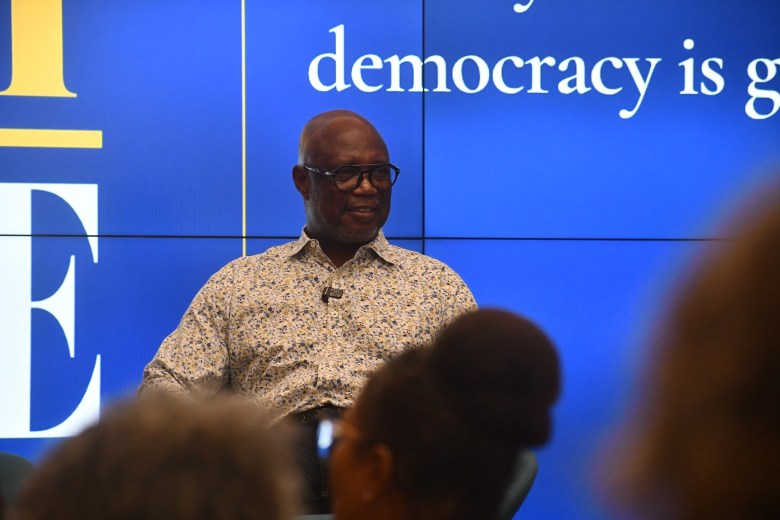
Houston NAACP President Dr. James Dixon says civic engagement must confront both voter distrust and misinformation.
“With all of the headlines and court cases, there seems to be a lot of distrust around elections,” Dixon told the Defender. “Does their vote count? All of these questions. We’ve heard them for decades, but I feel like they’re getting louder now.”
Dixon’s concern is especially relevant in Texas, where the nation’s latest push for voter suppression efforts began.
“Texas is the number one hardest state in the nation to vote in,” Dixon said, adding that low participation leaves potential political influence unrealized.
“We could have turned out 700,000 votes in 2024, and we would not be in the situation we’re in right now,” he said.
Dixon asserted that more than a million Black and Hispanic votes didn’t turn out in 2024. Still, one poll concludes that 74% of young Black men are expected to vote in the upcoming 2026 election.
Organizing men
National organizations are already preparing for November. The NAACP, 100 Black Men of America, National Urban League, Black Men Vote, Woke Vote, and State of the People announced National Black Man Voter Day, a coordinated initiative launched in September. Its goal is to mobilize 100,000 Black men ahead of early voting, which begins Oct. 19.
Houston-area engagement can also flow through local churches, HBCUs, Divine Nine organizations, and civic organizations.
Resources include:
- NAACP Houston Branch: Local civic engagement and voter education. (www.naacphouston.org)
- 100 Black Men of Metropolitan Houston: Mentoring, community leadership, and chapter-based outreach. (www.100bmoh.org)
- Houston Area Urban League: Civic and community initiatives. (www.haul.org)
- Black Men Vote: Black male voter mobilization. (www.blackmenvote.org)
- Harris County Elections Department: Registration, polling locations, and voting information for Houston-area voters. (www.harrisvotes.com)
The work ahead
Dixon believes participation requires urgency, not resignation.
“We have been docile and a little bit lethargic, not understanding that we are in the pot that’s boiling, and it’s turning up the heat so slowly, [but] now we’re starting to cook,” he said.