Monica Henderson had never seen a Black woman fly a drone for a living until she saw one doing it on her own Facebook feed.
That was enough to send her looking for a class.
“It was just to draw in the energy of seeing somebody that looks like you in a space that you know absolutely nothing about,” Henderson said. “But it looks like such a dynamic space to be in.

She reconnected with an old acquaintance, Steffanie Rivers, after watching Rivers’s drone-flying videos online during the pandemic, and then followed her into the industry. Henderson, who lived in Houston before relocating to Dallas, got licensed in 2025 and now helps teach prep courses at Rivers’ TCB Drones Academy.
Rivers founded TCB Drones in 2021 after the COVID-19 pandemic upended her airline-industry career, following years as a television and newspaper reporter. With flights grounded, she researched emerging industries and landed on drones, later launching TCB Drones Academy, which, she said, made her the first Black woman in Texas to register both a drone company and an academy. Now she wants Harris County to become part of her plan to close a racial gap in one of aviation’s fastest-growing career fields.
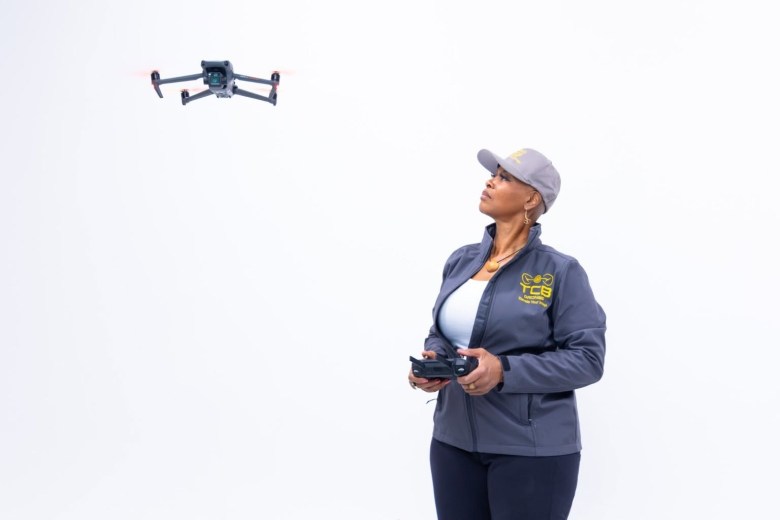
Rivers said her longtime chief drone pilot also lives in the Houston area, and the academy’s virtual courses have already drawn students logging in from the city, even without a physical office in Houston.
“We do B2C, or business-to-consumer, work, so we help the individual to be ready to take on tasks in the Houston area,” she said. “We are readily available … to help individuals … build a stream of income in this industry.”
The company also runs workforce development training for veterans and for organizations building drone teams. Henderson’s experience is exactly what Rivers hopes to replicate at scale. Citing research compiled by her own team, Rivers said minorities make up less than 3% of the nation’s FAA-certified drone pilots, despite a fast-growing industry with paying work in construction, real estate, utilities, agriculture, public safety, and delivery.
The low representation of Black individuals in the drone industry is due to socioeconomic barriers, historical exclusions from aviation, and insufficient early exposure to the field. As the drone market connects traditional aviation and technology, both of which have faced diversity challenges, it has adopted similar systemic issues.
“Where are all the other sisters and brothers?” Rivers said. “ I began asking myself after repeatedly finding that I was the only Black person, or the only Black woman, in industry meetings for drone contracts.”

Henderson said the lack of awareness keeps most Black people out of the field. She recalled a Houston-area high school career event where students, teachers, and even the principal didn’t realize a 16-year-old can get FAA-certified and earn money with a drone.
The FAA’s Part 107 exam costs $175, and applicants must be at least 16 years old. The academy’s prep course runs three days, five hours a day, virtually or in person, with recorded sessions for students juggling full-time jobs. Age has been no obstacle. In July, one of Rivers’ 16-year-old students passed the exam within 30 days of finishing the course, alongside a retired Georgia state trooper who had nearly quit midway but ultimately passed as well.
“Every time I get that email or that call and people tell me that they passed and they’re so excited, it just warms my heart,” Rivers said. “These are people who never saw themselves doing this until they saw somebody who looks like them.”
That transformation plays out across a wide range of students, from teenagers to retirees. From her years in Houston, Rivers said local opportunities extend well beyond inspections, into the events scene, film and music-video production, and even power-washing high-rise windows.
“Where are all the other sisters and brothers? I began asking myself after repeatedly finding that I was the only Black person, or the only Black woman, in industry meetings for drone contracts.”
Steffanie Rivers, Founder, TCB Drones Academy
For anyone on the fence, Henderson pointed to flexibility as the field’s biggest draw. Pilots can work in-house for companies building drone teams, or take contract jobs with real estate agents, farms, and event planners. Her only regret was not deciding sooner which specialty to pursue.
Rivers said that bringing more support to Houston means building on existing relationships, including two team members who know the city.
“Success is not going to show up at your front door like a package that you ordered,” Rivers said. “You have to go get it.”
For more information, visit www.tcbdrones.com.