The Trump administration is operating like a see-saw of chaos—swinging wildly between sweeping declarations and abrupt reversals.
One day, USDA scholarships are revoked, sending students and their families into a panic. Days later, the decision is reversed with a casual “never mind,” as if the emotional whiplash doesn’t count. Black trailblazers like Jackie Robinson and General Colin Powell are scrubbed from federal websites, only to be quietly added back when the backlash gets too loud.
Tens of thousands of federal workers are fired one week and forcibly rehired the next. Tariffs rise and fall depending not on any discernible strategy but on the temperature of one man’s mood. Deportations openly defy court orders, pushing the nation closer to a constitutional crisis.
The only constant? Volatility. And the cost of that instability is falling disproportionately on communities of color.
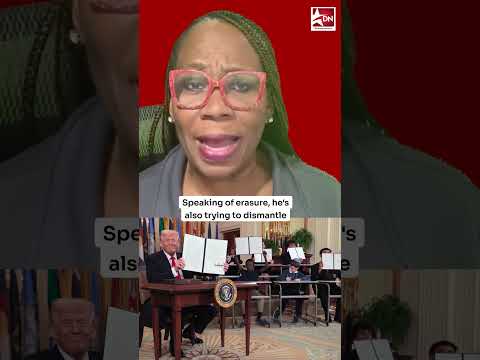
Recent policy decisions and executive actions by Donald Trump have sparked deep concern and unease within the Black community. From the rollback of civil rights protections to eliminating diversity and equity initiatives, these moves represent more than political shifts. They threaten to unravel decades of hard-fought progress.
As these developments continue to unfold, Black Americans are expressing heightened anxiety about what they signal for the future of racial equity, justice, and inclusion in this country.
“We’re exhausted—and it’s still early,” said Prairie View A & M political strategist Malachi Crawford. “But I do worry that he will sow so much discord that folks will just become immune until the damage has been done.”

“I am extremely concerned about the direction that the government is headed,” said Tomayai Calvin, whose daughter was among those who had her USDA scholarship canceled and then reinstated. “Every day it’s like – it can’t possibly be this bad and boom the Department of Education is letting go of people. Then topped off with kids losing scholarships. This is a complete disaster and the American people are being used in a game against ego and ratings.”
Here are some of the most stressful and potentially damaging actions the Trump administration has unleashed so far.
Shutting down the Department of Education
One of the most alarming proposals to emerge from the Trump camp is the shutting down of the U.S. Department of Education—a move that would carry significant and far-reaching consequences for students across the country, particularly Black students.
House Minority Leader Hakeem Jeffries (D-NY) has been a vocal critic of the plan, warning of its devastating impact.
“Shutting down the Department of Education will harm millions of children in our nation’s public schools, their families and hardworking teachers. Class sizes will soar, educators will be fired, special education programs will be cut and college will get even more expensive,” Jeffries said in a statement.
The Department of Education plays a central role in ensuring access, equity and accountability in American education. It administers Federal Student Aid (FSA), the country’s largest provider of financial assistance for students. From Pell Grants to work-study opportunities to federal loans, the FSA helps make higher education attainable for millions.
According to a 2020 report, more than 70% of Black students received grants—compared to 61 percent of white students—and 50% of Black students relied on student loans, versus 40 percent of their white peers. The elimination of this department could sever access to essential resources that help Black students enroll in and complete college.
“Every day it’s like – it can’t possibly be this bad and boom the Department of Education is letting go of people. Then topped off with kids losing scholarships. This is a complete disaster and the American people are being used in a game against ego and ratings.”
Tomayai Calvin
Beyond higher education, the DOE also manages billions in funding that supports K-12 public schools through programs like Title I—which targets low-income communities. In 2023 alone, Congress approved over $18 billion for Title I.
Despite the Department not having authority over local school curricula, Trump has used it as a political target under his broader “anti-woke” agenda. On January 29, he signed an Executive Order titled “Ending Radical Indoctrination in K-12 Schooling,” threatening to revoke federal funding from schools that teach what his administration deems “harmful” or “anti-American”—including lessons on race, racism and systemic inequality.
Although dissolving a federal agency requires congressional action, the administration doesn’t care.
Targeting the Federal Workforce—and the Black Middle Class

Trump’s sweeping purge of federal employees has emerged as one of his administration’s most aggressive efforts to reshape the federal government. Framed by the administration as a necessary crackdown on “bureaucratic bloat” and government waste, the reality is far more alarming for those paying close attention—especially within the Black community.
The nation’s largest employer is the federal government, with just over 3 million workers. Black Americans make up more than 18% of that workforce, despite comprising only 13% of the U.S. population. That overrepresentation has long made federal employment a reliable path to economic mobility and stability for many Black families.
But now, advocates and Democratic lawmakers warn that Trump’s campaign to downsize the federal government could deliver a crushing blow to the Black middle class.
The numbers speak volumes. Black workers comprise roughly 30% of employees at the Department of Education, 20% at the Department of Health and Human Services and 24% at the Department of Veterans Affairs. These are precisely the agencies now facing deep staffing cuts under Trump’s Department of Government Efficiency (DOGE)—a unit helmed by billionaire Elon Musk and tasked with slashing jobs and streamlining operations.
Black employees may be disproportionately affected by these reductions, raising serious concerns about targeted job loss and the erosion of workplace diversity across the federal government. For many Black professionals, federal employment has provided financial security and’s been a means of breaking generational cycles of economic inequality. The loss of these jobs could roll back decades of progress.
As Trump pushes ahead with his vision of a “leaner” government, critics argue that it’s not just about cutting red tape. It’s about cutting out the very workers who keep these agencies running, and who just so happen to be Black.
Rescission of the Ban on Segregated Facilities in Federal Contracts

In a move that has alarmed civil rights advocates, the Trump administration rescinded a clause in federal contracts that explicitly banned segregated facilities, such as separate waiting rooms, restrooms and dining areas, based on race or other characteristics. This clause, in place since the 1960s, was removed following a memo from the U.S. General Services Administration, which cited alignment with Trump’s executive order targeting diversity, equity and inclusion (DEI) initiatives.
While segregation remains illegal under federal law, critics argue that eliminating this explicit prohibition sends a troubling message and could undermine decades of progress toward workplace equality.
Dismantling of Diversity, Equity, and Inclusion (DEI) initiatives
Trump’s executive orders have led to the elimination of DEI programs within federal agencies and among federal contractors. This includes revoking protections established under previous administrations, such as Executive Order 11246, which prohibited employment discrimination and required affirmative action. The removal of these initiatives is perceived as a rollback of efforts to address systemic racism and promote workplace diversity, potentially reducing opportunities for minority groups.
Reversal of Environmental Justice policies
The administration’s decision to reverse policies prioritizing environmental justice has raised alarms about the health and well-being of Black and Latino communities, which are often more heavily affected by pollution. The disbandment of teams dedicated to supporting these communities and eliminating initiatives like “Justice40,” which directed benefits from environmental programs to disadvantaged areas, have left grassroots organizations seeking alternative ways to combat pollution.
Impact on Civil Rights and anti-discrimination enforcement
Efforts to roll back civil rights protections, such as attempting to end enforcement of the Civil Rights Act in cases of “disparate impact” on minorities, have raised concerns about decreased accountability for organizations with policies leading to racially disparate outcomes. This could affect areas such as education and law enforcement, where systemic biases have historically disadvantaged Black individuals.
Collectively, these actions have contributed to heightened anxiety and stress within the Black community, as they are perceived to undermine progress toward equality and justice.
Here’s the reality check no one wanted but everyone needed: Donald Trump is back at it again, making policies that seem custom-built to stress out Black America. If you thought his first term was a masterclass in chaos, buckle up because his latest moves are hitting us like a rigged game of spades—completely unfair but somehow still shocking.
“The sad part in all of this is that this list continues to grow,” Crawford said. “And I have a feeling it will be as thick as Project 2025 by the time this is all over.”